Showing posts with label TheArtifact. Show all posts

2026-06-07

It's an expo, it's about games, it's in the UK

Another UK Games Expo has come and gone, and if you are paying attention to analogue games news, you may well have seen the numbers, which are significantly up from last year, and almost double the pre-Covid peak attendance. The event now occupies all five of the main halls (though with some unused space in some of them) around the NEC's central piazza space as well as a load of smaller rooms and a significant portion of the nearby Hilton hotel. It's not the biggest event of its type in the world, but it is flipping huge. I played only a handful of games (all on Friday night as it happens), but that isn't the point for me...

As has been the case for the last few years, my involvement in Expo has centred on the Playtest Zone, which was in the same spot as it was last year, which is a great little area at the side of hall 2, alongside a load of stalls related to university game design programmes and the Panda GM area that provides spaces for ad hoc meetings to anyone who needs them, which is a great facility to have.

The Playtest Zone in full flow.

There were over 200 game designers with us over the three days of the show, with a huge variety of games, the prototypes varying from shiny, professionally printed ones, all the way down to cards hand-drawn in pencil. I can tell you that I have a real soft spot for the games that are closer to the basic end of that continuum. Unfortunately I didn't get to play any of the games, but the buzz around the place was amazing.

For big chunks of time, we actually had a queue of players wanting to test something, and they stood incredibly patiently for spaces to become available. It's a wonderful thing to see how many people want to play unpublished games, and how many come over specifically for the experience. And hanging out with such a wide range of game designers and other folks (especially the other volunteers) is always a pleasure and a privilege.

Time for a little rant, though... Every year we have a few designers (or even publishers) booking playtesting slots, where it is clear that their objective is to promote their crowdfunding project. The most egregious one of these I spotted this time was a very nice crew who finished their spot and as they were packing up I asked (as I often do) how things went and whether they had useful feedback. Their answer was that it was great, but they weren't looking for feedback because the game was done. I stepped away at that point and did some breathing exercises.

So what? Well, the objective of the playtest zone is to enable designers of all levels of experience to get feedback from "normal" gamers, while also providing something fun and interesting for those gamers. We explicitly aren't there to provide a free demo table for publishers. We don't really have the ability to stop this sort of stuff happening, but if you are reading this and are someone who is looking to promote your game, please know that I understand how hard it is to build up a buzz around your game and you just want to take opportunities, but you are preventing another designer having an opportunity.

Note: I am just a regular volunteer and opinions expressed here are my own and do not necessarily reflect those of anyone who organises anything or is in any position of authority.

Magical Artifacts around the middle of the game.

Back on the main plotline, I had a playtesting slot, and this time it was Magical Artifacts, which was played by a group who had played some of my games in previous years (thanks folks!) and threw themselves right into the game. Unfortunately we didn't quite get to complete the game in the allotted time (an hour of play for four players and we had a couple of rounds left to go), but I got some useful notes. The key stuff is still to find ways to make some rules explanations clearer, and probably to tighten up cost and benefit balance a bit.

Something else I'd like to mention is the Indie Market, organised by the lovely folk who organise the Bastion convention that I have been to a few times in North Wales. This was a room with some 15 or 16 designers selling small print run games for a couple of hours, and this had a huge queue of those of us who wanted to buy stuff, which meant big delays to get into the room. It seemed to be a huge success overall, and I understand the Expo organisers are planning to allocate more space to this for next year. 

It has basically taken me a week to get myself into a state where I can think about or do anything much, but now I'm back, and I'm still buzzing about the amazing vibes from the event. I'm looking forward to next year already.

An ironic sign at the Hilton. To be fair, this was at the bar,
while they had a huge amount of other space for folk to play in.


2026-03-31

Introducing The Artificers...

Oh good grief, it has been a long time since I wrote a blog post. I haven't stopped working on games, so let's catch up on one of the projects I have on the go...

So, The Artifact, the game I have been working on, mostly online, with Alex Cannon for quite a while now that has been through a good few iterations based around a core mechanism that is pretty much unchanged since the early days. Last year we had a really interesting playtest with someone who happened to be part of a game publisher. They gave some really interesting suggestions (being very careful to stress that this was not advice on how to get them to publish it) which we thought about, and then decided to run with to see where it would take us.

The first physical playtest of the new version, with hand-made cards because
muppet here had forgotten to bring the cards he printed and cut out the day before.

One of the biggest points was that all the way through our work, we had clung to a concept of the game being effectively a race to complete a certain number of objectives (though more recent iterations involved a sort of tic-tac-toe element on top); the advice was to try turning it into a more standard victory point game. This basically involved killing one of our darlings, but we thought, why not? If we couldn't make this work properly, we could always roll back to what we had before.

The other key suggestion was to move away from our initial setting, which was about exploiting alien technologies, and go with something more "boring". This may seem counter-intuitive, but I think the overall thrust was that the core mechanism (the way resources are accessed and exploited) seems reasonably novel, so fitting that into a more vanilla fiction and mechanical structure would be more comfortable to a lot of players - and, to be honest, it would probably work out being easier for us to actually finish.

And so, we now have a pretty generic fantasy setting, where players are building a series of artifacts, making use of magical resources that their assistants are collecting from around the land, with the artifacts being built providing various combinations of special abilities and victory points. The title, The Artifact, just doesn't seem right any more, so I've taken to calling the game The Artificers - though maybe better would be something like, Artificers of Ambivalencia...?

After some online development, Alex and I finally got a physical prototype built and met up to test it - we live a few hours apart, so this sadly doesn't happen often. A first play-through went OK, so we then concentrated on playing through the first few turns of the game a few times in a row, trying different setup options and seeing what would happen if all the random elements conspired to make things as frustrating as possible. It took a couple of rule tweaks until we were happy that things looked pretty solid, but obviously this was just with the two of us playing.

Another playtest: this time, four players, none of whom were me!

I've had a couple of playtests so far since then and it's looking promising so far. The previous major version of the game was usually taking something like half an hour to play in physical form, but we're now looking more like an hour, which actually seems appropriate for the weight and style of the game. 

So it seems we have a solid direction of travel here, and we have actually started talking about game balance, which is something that neither of us usually spend too much time on, and we think this might mean that the game is finally getting to a pretty mature state. Obviously a load more testing is required...

2025-06-12

So, That Was Expo

A couple of weekends ago was the biggest event of my personal gaming year, UK Games Expo - if you don't know about it, it's held at the Birmingham NEC venue plus a big chunk of the nearby Hilton Metropole hotel at the end of May and beginning of June each year and is one of the biggest (mostly analogue) gaming events in the world. It's not the time or place where I play the most games (I usually play very few), but it's when I see so many gamers, game designers, publishers, and general nerds. 

Lots of people sitting at tables, playing games, in a big hall.
The Playtest Zone in full flow, tables loaded and buzzing.

This time, the halls at the NEC were differently set up to in previous years, meaning that the main event areas were all on the same floor level, which was nice. I haven't checked this, but it also felt like the aisles between stalls were wider than before. This, plus the arrangement of entrances to the halls, accessible from all around the central NEC concourse, and the lack of choke points in the direct connections between halls (which were just open) seemed to contribute to a more relaxed and open feel than I am used to, despite attendance being higher than ever. Sure, it was busy and crowded, and at times it was pretty stressful to get around some areas, but overall it seemed a happier place to be for me.

I spent most of my weekend at the Playtest Zone, which was off in a corner of hall 1, but had good levels of footfall pretty much all weekend. The arrangement is that there are a load of tables (we had 24!) which game designers could book for a period to test one of their prototypes, then regular convention-goers come, play the game, and give feedback. As volunteers in this area, we are basically there to facilitate this, to help things move smoothly, make sure (as far as we can) that designers are matched up with players, and so on. As part of this, I found myself talking a lot, often with people who just wanted to know what was going on and how to get involved, but also, significantly, with new designers who wanted to know how they could get to a state where they were testing their games at Expo next year. I'm planning to write up a summary of some of the advice from those discussions shortly after this post.

A person holding up a sign that reads, "Hot, fresh, locally-sourced games to playtest."
One of our volunteers with the special sign she had specially made.

Apart from the volunteering and talking, I did get to run a playtest of The Artifact and got some very useful feedback. A major part of that was comments about the theming of the game not being strong, which I partially agree with; I think, though, that I taught the game largely as an abstract game and things could be improved a lot by changing that as well as some graphical upgrades. We have some good comments to be thinking about though.

I did get to play a few games, of which only two were recently released: Fighting Fantasy Adventures, which was a fun way to spend an evening making some new friends, and Grab Bag Jungle, just because. The rest were a couple of very lightweight, silly games and a prototype a friend had with him.

Which reminds me that I do work on light and quick games occasionally, so I should get some of them out for those situations. Hanging out with game designers at these events does seem to mostly involve playing silly stuff or small prototypes. Also there is often beer. When in those situations and someone says, "So, do you have something?" the answer should always be "Yes!"

A prototype game, with colourful tiles and tokens, and hands moving things about.
A playtest of The Artifact drawing close to its end.

I'm not someone who is particularly good in social situations at the best of times, and spending a lot of time in loud, busy situations, and doing a lot of talking, can wipe me out mentally and emotionally. This can be a problem when the whole point of the event is to meet and interact with people. I've got into the habit of having a quiet hour or so back at the hotel, just having a lie down and a mug of tea, at the end of each day, before attempting to socialise in the evening, and this seems to help a lot.

Oh, and this was my first Expo as an officially published game designer, and it was great to see Gibsons demoing and selling Grab Bag Jungle - as well as giving out lovely Jenny The Jaguar enamel badges.

Overall, this was another amazing event, but it took me most of a week to get my head back into a state where I can be productive again. I am still riding high on the sense of community and the love for playing and designing games shown by the folk I was hanging out with. Now I need to turn that into progress...

2025-05-27

Grab Bag Expo

Just a quick one this month. As you may be aware, UK Games Expo is almost upon us. This is the UK's biggest games convention, and takes place in the National Exhibition Centre, near Birmingham, and occupies several of the NEC halls, plus a big chunk of the nearby Hilton hotel as well as some outdoor areas. It's a big event, and runs over the coming weekend, the 30th of May to the 1st of June.

This is a huge part of my year and I'll once again be spending pretty much the whole time (at least the part when the trade halls are open) at the Playtest Zone, which will have more than 20 tables of prototype games looking for players, and those games will be changing regularly through the event, so if you fancy helping test an unpublished game, please do come along any time. We're in Hall 2 (the easy to find Stand 2-108) and it would be great to see you there.

Last year's playtest zone getting pretty busy.

I'm not planning on pitching any games this time, but will have some prototypes with me anyway. I have a playtesting slot booked for 16:30 on the Saturday (the last slot of the day), and am planning on testing The Artifact.

Other than that, I will use the free time I do have to potter about and see what (and who) I can find. I'll mostly be looking for interesting indie games, both board and roleplaying types, and I'll probably also treat myself to a new mug from Haus of Banshee (2-294). Oh, and this will be my first event as a "properly" published game designer, so I'm excited to see Gibsons (2-460) showing Grab Bag Jungle.

I'll let you know how things go.

2025-01-26

The State of Play

So, it's another new year and I guess that's as good a time as any to reflect a bit and think a bit about where I am from a game design point of view. How did the last year go, and how am I planning to move forward?

Well, I'll start with the biggest point from last year: I signed a game with a publisher. I haven't been given the nod to start shouting about this yet, but will give you the lowdown as soon as I can. The publisher has been showing some early copies of the game at trade shows this month, so it should be imminent. This is exciting stuff, and I can't wait to tell everyone, but patience is important as part of building a good working relationship.

A game in progress with rows and columns of cards representing castles, soldiers, etc, plus dice and a raven figure
The Castle War as it was around August last year.

Other than that, I worked with another designer on a game based on one of their past (unpublished) design that developed into something significantly different, and we have already pitched that to a publisher, who has taken a prototype for evaluation, and we are hoping to hear back in the next month or two.

Ongoing project, The Artifact, about which I have posted here a number of times, is chugging along. I've been working with co-designer Alex Cannon mostly online, though we have met up a couple of times and played the game, plus have both managed some physical tests with other folk. The game is feeling like mechanically it is pretty much sorted, but one aspect, a "project board" that effectively handles the scoring and victory conditions, is proving tricky to get right. I think we are close though, and we are hoping to be able to pitch it for publication some time this year.

My card game, The Castle War, has also made some significant progress, in partnership with a publisher. The game is not officially signed, but I am content with how we are moving along with this one, and the game is finally feeling pretty solid. 

The other game I have done significant work on in 2024 was Sympolis, my card and dice cooperative game. In a similar way to The Artifact, the core mechanisms of the game are working well, but I've been struggling to get the finishing details locked down; in this case it is how to balance the challenge so the game feels like it builds to a tense culmination. Unfortunately, here I don't have the luxury of a co-designer to work with on these issues. I have some ideas that I am experimenting with though, so I'm sure I will get there.

Reflecting on this for a moment, I think that I am learning that I am stronger at working on a core engagement than I am at delivering a punchline. I have had playtests of Sympolis, for example, where the players have really been chewing on the challenge and engaging strongly, only to be disappointed when that tension dissipates into an unsatisfying endgame. I think this is partly because I am inclined to just sketch out a rough endgame and leave it like that while I do everything else. This can work fine when it's a straightforward duelling game, or a classic "play ends, then count up points" Eurogame, but not so much in most of the games I have worked on lately. I should watch out for that.

More generally, how was the year? Well, aside from the obvious high points, I have picked things up a fair bit from the lows I reached a year or two back when the get up and go had thoroughly got up and gone. I'm still not good at organising playtesting sessions, but I have been to some good events (a couple of invite-only playtesting weekends, for instance), and have got back into the swing of regular meetups with a couple of other game designer friends. I still have a long way to go in really getting back in the proverbial saddle, but the direction of travel is correct, I think.

So for this year, I think it should be more of the same, and probably more more of the same. I'll be meeting up with designers, attending a small number of conventions and games days, volunteering at the playtest zone at UK Games Expo, and hopefully actually sorting out more regular playtesting locally. Maybe even pitching a game or two. I've been really feeling good about collaborations with other designers - some have worked well so far, and some not so much, but that's to be expected - so I'll keep looking for opportunities to work with others.

I'm also tinkering around with roleplaying games a bit more again, which is a hobby that used to take up most of my time before I switched priorities into board games. Hopefully I'll get to play and run RPGs a bit more than I have been. The "random table per day" challenge I set myself last year was roleplaying-adjacent, and I'm thinking about working with some of that material to see if I can turn it into something more.

Other than that... I'm not really one for new year resolutions, so I think keep on going, be kind to myself, and try to help others... that'll have to do for now.

2024-09-29

Updates and Artifacts

Just a quick update... 

I've been slowly chugging along over the last month, keeping things moving along with The Artifact, and also reestablishing a monthly meetup with another semi-local designer who I used to see a lot of before Covid. A big part of things is building up a routine again. 

Interestingly, the semi-local meetups have already resulted in a new design, a light, cooperative puzzle game which we think is close to pitchable already. Obviously we'll be continuing to work on it, but it's looking pretty good so far. 

I've also had a tinker with something very new that didn't work, but I want to play with a little more. I'll probably write up something about that soon.

The end of a recent 2-player test of The Artifact. 

The Artifact has stayed in roughly the same state for a couple of months now, with Alex and I both having tests independently, trying out different variations of the game in relatively minor details and comparing notes. This seems to be working well and making progress a lot better than we have managed for a good long time. It helps that we have found a core of the game that we are both pretty comfortable with and can iterate on at a relatively fine level.

I'm also at an interesting point with my approach to the game where I am actually starting to think about balance between elements of the game. This is something I tend to resist for a long time when working on games for a lot of reasons, so the fact I am allowing myself to even start thinking about it makes me think that things are really moving.

2024-07-28

New types of artifice

If you've been here a while, you might remember about The Artifact, a project I have been working on since... ages ago with co-designer Alex Cannon. We've been working on this mostly in a virtual form (implemented on Screentop.gg), and have had a core to the game, about which we have tried a heap of different approaches to make a full game. Some of the iterations have been quick and light, and some have been crunchy brain-burners, but none have really felt right to us.

We got into another fresh approach a couple of months or so back, which felt good. Alex managed to arrange some in-person playtesting which helped develop the idea into something that worked pretty well, and I was able to get some further tests that have added some additional shape to the project. After a period of slow progress, we have got into something of a rhythm with one of us doing some independent testing and development, then working together to consolidate, then the other doing something, and so on...

A recent 2-player test of the game on Screentop.
Note the very basic "it'll do for now" grid on the right -
enough to test with and no more.

It feels to me that we have reached a shape to the game that we enjoy playing and shows promise. It still has plenty of flaws, some of which we have identified already, and some we are sure exist but will need testing to find, but we seem to have a workable direction of travel for now.

The core of the game has always been built around placing domino-like tiles to a central play area, placing "researcher" tokens onto these, and using those researchers to access "knowledge resources" on the tiles to gain... something, generally including "projects" that progress towards victory, but in some iterations there have been other things involved.

Right now, added to the spatial game of building the array of tiles and having researchers in the right place to achieve objectives, we have a secondary board representing the projects and developments that can be achieved using the researchers and the resources they access. This board provides a second spacial element as victory comes from connecting up a group of completed spaces on its grid, and as you complete projects you get actions which can manipulate the state of the tiles, so there is a circular dependency.

A 3-player test that got really bogged down and ground to a stop.

This all works pretty well for two players, but for three, it seems a lot more patchy and the current setup can get bogged down quite badly, with some turns involving some serious puzzling out, and active blocking moves making it very difficult for someone to win. That latter point can certainly be addressed, and we'll have to see if the former is a problem for players. We haven't yet tried more than three players. I think that there are ways around this though, with plenty of elements we can adjust, including costs of projects, layout of the project board, effects that take place with completed projects, and so on. We'll be exploring this over the coming weeks.

We're likely to continue to test primarily with two players for the time being, there being the two of us working on the game, but we'll increasingly have to look at higher player counts. It might be that we can get it to work great for two but struggle with more, and that's fine, but would frankly be a little disappointing. There may need to be variations in setup for different player counts, and this is something we already have some ideas about.

All in all though, progress is good.

2023-09-07

Sen's Lens

You may have come across Sen-Foong Lim, an experienced game designer with an impressive portfolio, and part of the Ludology and Meeple Syrup teams, as well as plenty of other cool things he has done. Well, he recently shared an image titled, "Your Board Game Critique. Things I'd probably tell you if I had playtested your game", I believe initially on Facebook, but it soon started getting passed around on Twixxer, Bluesky, and I assume other bits of social media too. I gather there was a bit of pushback due to the slightly blunt language, but I was instantly taken by the truth of the document. I have heard most of the points Sen makes aimed at my own designs over the years, as well as at other people's games.

A day or two later, Sen released an updated version with slightly softened and also tightened up language, but making the same points, and I've added this version below.

YOUR BOARD GAME CRITIQUE Things I'd probably tell you if I had playtested your game to help you improve your next iteration. 1. There's way too much going on. Identify the specific experience you want to curate inside of the game's box; remove everything that takes away from that. 2. The audience for the game is ill-defined. Identify the game's audience, specifically, and ensure that it meets the players' reasons to set it up again and again. 3. This will cause headaches at manufacturing. Design to real-world manufacturing considerations. Make a physical prototype instead of relying solely on a virtual one. 4. There are a lot of rules that are easily forgotten. Design edge cases out. If a rule is rarely used, find a way for it to be more impactful or remove it completely. 5. The game is 1.5 times more clever than it needs to be. The game should provide a great first experience that isn't confusing or that makes players feel lost. 6. Innovation can be a trap. More often than not, players want something that they know and understand with a twist, not something that comes out of left field. 7. Modularity can be a trap. Ensure that the game works as intended in every configuration of the set up that the game allows. 8. The game takes too much time and effort for the amount of fun it provides. Simplify the core play loop and reduce procedural actions required for the game to "run". 9. The game does not communicate the rules well. Focus on writing rules over lore and the graphic design over illustration. 10. Rules need to be wherever the players think they should be in the rulebook and on the components. Use call out boxes, marginalia, player aids, and on-component text. 11. There's a disconnect between the game's promise and playing the game by the rules versus what I hoped to be able to do in the game. The game's theme and mechanisms should inform each other to support the intended experience. 12. I'd rather play a shorter version of this game twice, even if the total amount of time would be more than playing it once in its current iteration. Hat tip to Jim Zub and Steve Lieber for their comic script and portfolio critique lists, respectively. Thanks to Chris Schweizer for the art. This is from a larger piece in which Chris captured he, Jay Cormier, Matt Kindt, and I playtesting a prior version of Mind MGMT at Gen Con in 2017. Find me:  @senfoonglim  @senfoonglim.bsky.social
I first saw the list just before a planned chat with Alex, who I am working with on The Artifact, a game project that I need to blog about again soon (though this post kinda counts). We're working through some structural ideas at the moment and trying to figure out if we are on the right path, and Sen's points proved to be a really useful starting point for discussion. We went through the list, point by point, and had a discussion about whether that criticism applied to our project. 

So, is there too much going on? Is anything detracting from the core experience? Maybe - we have a couple of elements that are currently a bit extraneous, but overall we think the game is about the level of intricacy we want.

Is the audience ill-defined? We have to admit that we're basically making a game that we'd like to play together rather than having a strongly defined target, which probably isn't great for when we get around to pitching the game.

Would the game be painful to manufacture? We don't think so - despite having been developed mostly in virtual form, it is manufacturable with a pretty standard number of cards, a few punchboard sheets for tiles, and not-that-many additional tokens (maybe wooden, maybe punchboard), plus a board, so while it won't be a budget game, it shouldn't be a problem.

...and so on. We got to identify a few things that need further thought, and had some good discussion  about some other areas that should help us move forward. We've both worked on assorted games before, and this game has been through a good few playtesting loops, so we were pretty sure we wouldn't be too far off the mark here, but it's interesting how revealing it can be to just work through some of these basic points.

If you're working on a game yourself, I'd really recommend having a look and asking yourself to answer honestly to each point: does this apply to my game?


2023-03-05

Starting over for a new year - March is the new year, right?

Over the last couple of years, the board game design part of my life has stagnated quite a lot. While online game development and testing works pretty well, it turns out that I am most energised by regular face-to-face sessions of testing. Before Covid, I was visiting London for an afternoon of playtesting most months, having a monthly meetup with a couple of semi-local designers, and having occasional other testing opportunities at other times too. It was never the several-times-a-week testing that some folk manage, but it kept things moving along pretty nicely.

In recent months, I have started getting back to the London meetup occasionally (not regularly yet), and we have just reinstated the semi-local meetup, though I've not yet tried recruiting other local playtesters again. 

During an email exchange with another game designer recently, it occurred to me that I used to enjoy writing this blog as a rough journal that encouraged me to get thoughts into some semblance of order, and very occasionally being the start of a conversation with someone out there. I've fallen into a cycle of not feeling I have much to say and editing myself too much, as well as finding all sorts of excuses why I shouldn't write anything. I don't think this is a helpful situation, so maybe I should just pull my finger out and write something.

So, in the spirit of getting things going again, I'll make a quick note of a few of the projects I have been working on recently...

The Artifact is a tile-laying and some-other-stuff game that I have been working on with Alex Cannon, almost entirely online. There is a core of game play that works pretty well and there are several other bits of game that we have tried, but while the game has had many forms that have played pretty well, there has always been something that we have been unhappy with. This has been a really interesting process, and I think we are gradually homing in on a game that we can then work on refining properly, but there is still a little way to go.

A 2D virtual tabletop showing a gridded board, with coloured domino-like tiles on it and various cards and tokens on the board and nearby

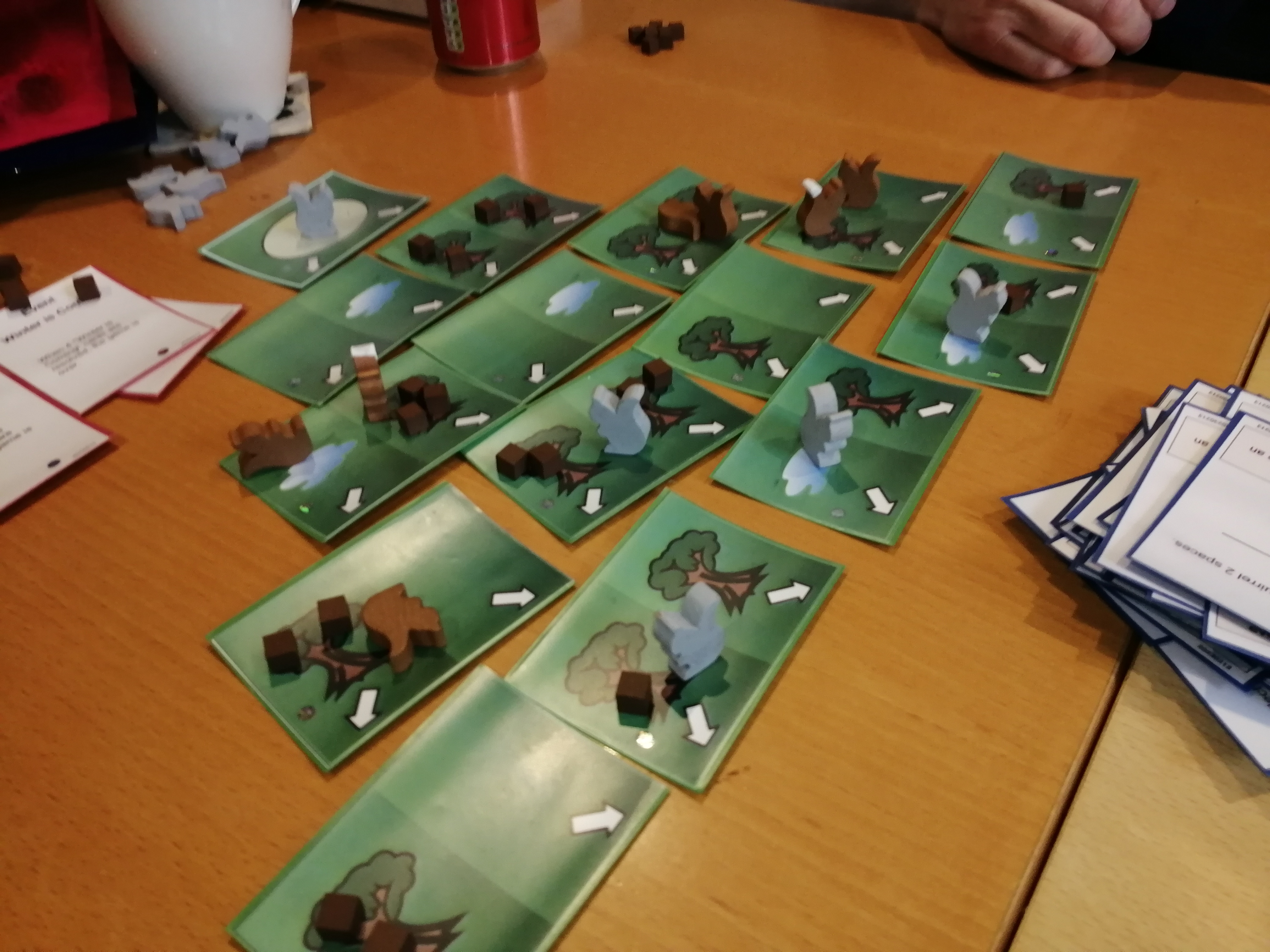
Squirrel Invasion is a re-imagining of a game that I was working on long ago, that long-term readers of this blog might remember as Invaded. The idea is that players control tribes (now of squirrels) trying to get by in their homeland, which is invaded by an aggressive, non-player, colonial power (grey squirrels). The current version is very light and plays more like a wonky family game than I would like, but it plays, which is something, and I have some ideas.

On a table, 15 cards that are mostly green, with illustrations of trees and ponds on them, all arranged in a triangle. On these cards are squirrel figures, some grey and some brown. Other cards and components are also in the table.

City State Co-op is an implementation (with a terrible working title) of an idea I posted about on this blog several years ago. The core idea is players each control city states in an ancient world that are beholden to demands from both their populace and the gods; the problem is that some of the demands involve attacking each other, and you need everyone to survive and thrive in order to win. I was stuck on this for a very long time, but a discussion a few months ago with Rory Muldoon got some good ideas up, and I now have a functioning version which I think has some merit, but the challenge curve is currently terrible.

On a table, several cards, with icons displaying buildings and other stuff, overlapping each other, and partially tucked behind a bigger card with tables on it. On these cards are 6-sided dice and small wooden cubes of various colours.

Now, let's see how often I can continue this blog...


2022-07-13

Physical Artifice

So, The Artifact...

Of the projects I'm currently working on, this one is probably the one that has most consistently been developing over the last year and a half. It is a co-design with the inimitable Alex Cannon, who I got to know through a couple of Twitch streams in the first year of the pandemic, and who has an uncanny mind for puzzles. Since January 2021 we have been having an online meeting most weeks, usually working on or playing a virtual prototype we had built in Screentop.gg, and sometimes just chatting, partly about life and partly about the project.

Then a few days ago we managed to get together with a physical prototype and play the game on a real table. We sat in a coffee shop for a while, drank beverages, had a couple of plays through, and talked through some of the implications of what happened in the games we played.

Coloured tiles arranged on a table with other game tokens placed on top of and around them.
A 2-player game (the blue meeples are replicants) coming close to an end.
Just off-camera to the left are project boards, which are the paths to victory.

Boy, I have missed this. While we have got this game a long way with essentially entirely online collaboration and testing, you can't beat moving components on a table, at least not when that is the intended playing format for the game.

The big headline is that the game felt pretty natural to the two of us to play, and took maybe half an hour or so per game. How it would feel to other people is unknown right now, but hopefully we'll find out sooner or later. The half hour of play felt pretty good -- a bit of brain crunch that might have been too much if sustained for a load longer -- but it occurs to me that maybe there are too many bits for a relatively short game. The setup and teardown is not exactly challenging, but... I dunno, it's just something in my head as I write this.

Just to catch you up, the central conceit of the game is that there is an alien artifact that has crashed to earth and we are corporations (or something) trying to research and exploit the technology contained within by assigning researchers to work on the expanding knowledge space that is represented by (mostly) domino-like tiles that get added on each player's turn. The game ends when one of the several project tracks off to the side is completed (each works a little differently with how they can be progressed and what benefits they provide, and there is a little interaction between them), and the completed project dictates the victory conditions for the game.

We've been tinkering with a new mechanism based on what we are labelling as alien slime (in this prototype it's to do with the yellow cubes and the black squares), which we think opens up some interesting possibilities, particularly adding more spacial elements to the game (which otherwise are less than you might think for a tile-placing game). The couple of variations on the mechanism we tried were underwhelming, but found some directions we could push in, and a later, virtual session experimented some more. Still a long way to go here, including considering whether we really should be using this. 

The Artifact has twisted and changed quite a lot in its 18 month history, with mechanisms added and removed along the way, but it has always revolved around the tile placement and use of workers/researchers to tap into knowledge resources on the tiles. We seem to have settled on a form of path to victory now, but in the last few months we have just been testing with the two of us while we made some major changes, so we don't have the important data from other people looking at what we have been tinkering with week in, week out, and that is potentially concerning. But I think we're getting to that point of going back to our friendly (but occasionally brutally honest) volunteers/friends and seeing what they think.


2021-04-09

Researching The Artifact

So, another game design project I have ongoing at the moment, and another collaboration. This one is working with Alex Cannon, who says I am allowed to blog about the project as long as I make him look good. I will do my best!

This game came out of one of the fabulously intelligent and charismatic Alex's occasional Twitter threads of game ideas, after I responded to a short idea along the lines of "friendly worker placement", where players maybe get benefits in some way from nearby workers placed by other players.  I couldn't help thinking about scientific research where, while research groups can be intensely competitive, the whole field relies heavily on the output of others. You know, the whole standing on the shoulders of giants thing. Or at least standing on each others' chairs.

We had a chat and after bouncing various thoughts around, we got to the idea of teams of scientists working to investigate a big alien artifact; a crashed space ship or something. The idea is to find ways to exploit the various forms of technology found in the artifact and earn fame, fortune and victory points!

A first shot at manipulable components, even if it wasn't actually a playable game.

As we live something like 100 miles apart and have been pretty much locked down due to Covid-19 restrictions, we needed to collaborate online. Our method so far has been to make notes and write rules in a couple of Google documents, alongside a spreadsheet for component data, all of which we are both able to edit. I built a set of nanDECK scripts for the various components, and can run those quickly to generate files that can then be uploaded to a Screentop.gg project that we both have access to. It means that I currently have to take action any time we want updated components, but unless there is some structural change required, it takes only a few minutes from changing the spreadsheet to being able to play.

Over the early iterations (we have been having a discussion, and usually a play of whatever we have set up at the time), we homed in on a few concepts that we wanted to build around, and which we have pretty much stuck with even though a load of other things have changed...

  • There are no victory points in the game; you win by being the first to achieve three objectives (in the form of "projects".
  • There are no spendable resources to gain and then spend; instead you just have access to levels of knowledge according to the positioning of your researchers (workers) and the layout of the board tiles.
  • On every turn, you add a tile to a central layout, with domino-like placement rules and can place or move one of your researcher tokens.
  • Access to knowledge via your researchers on tiles allows you to play cards to a personal tableau, representing your personal developments and special resources and capabilities.
Mid-February. The round markers are movable player tokens
and the squares are knowledge "resources".

We almost immediately simplified the tiles so that the ones that get played every turn are essentially two-square dominoes, largely for simplicity's sake, but we haven't really felt the need to change this, apart from having big tiles to add to the array when you complete a "project" (one of the objectives). 

The main changes apart from that have been to evolve the development cards that you are playing along the way, gradually adding more variety, restricting the number of developments you can have in your tableau, introducing a mechanism for upgrading from one development to another, and adding special actions to most of the developments. All this now means that there are all sorts of additional actions you can do on your turn, and you will end up losing access to some of them as you change your priorities in upgrading and rebuilding.

Up-to-date, with a three-player game and a lot more going on.

There is still a very long way to go in developing the game, but it seems to be evolving its own character and challenge. Last week we hit a milestone in having our first test play that involved a third player. While this definitely revealed a few shortcomings, as would be expected, our big takeaway was that the game did not completely collapse when played by someone who didn't design it. 

One of the most interesting points made by our third-party tester was that the game felt strategic but not tactical, and it that maybe there should be a better balance between the two -- or at least we should think hard about whether we want a game like that.  The observation was that to a very large extent you could make a plan early in the game, and then execute that plan, and the challenge was to complete the plan as quickly as possible, with minimal concern for what the other players were doing.

This is all a matter of perspective, as while the other player was executing his plan, Alex and I were getting in each others' way a bit, but the point stands: there was a different experience for different players and, at the very least, we need to decide if we are OK with that. And if we are not (in general, wildly different experiences between players might indicate a problem), we'll need to think about how to address it.

Did I make the talented and likeable Alex look good enough in this post? I guess only he will be able to rule on this.