Showing posts with label DraftyValley. Show all posts

2018-07-30

Four Get Drafty in Pimlico

Last month's Sunday playtest meetup in London got cancelled due to a clash with Fathers' Day, and this month's got rescheduled as its planned date coincided with the Men's Association Football World Cup final, but I was fortunately able to make the new date. Of course, the new date clashed with a big cycling event in the city, which caused travel chaos for some, but seven of us made it, then an eighth, and then a ninth, so all was well.

Before getting to my own game, I got to play a couple of games of a light card game, which is so close to being something I would buy in a heartbeat, and once through of a midweight Euro game, which I had tried an earlier iteration of, and is well on its way to being a great candidate for my game shelf too.  I'm very much looking forward to seeing how both of these turn out.

My game for the day was Drafty Valley, which I had tested a few days earlier as a two player game, and saw that the latest version appeared to be working OK, but seemed weak with only two players. I wanted to see how it fares with more, so was just sitting down as part of a group of three, when a fourth player arrived, making the setup perfect from my point of view.
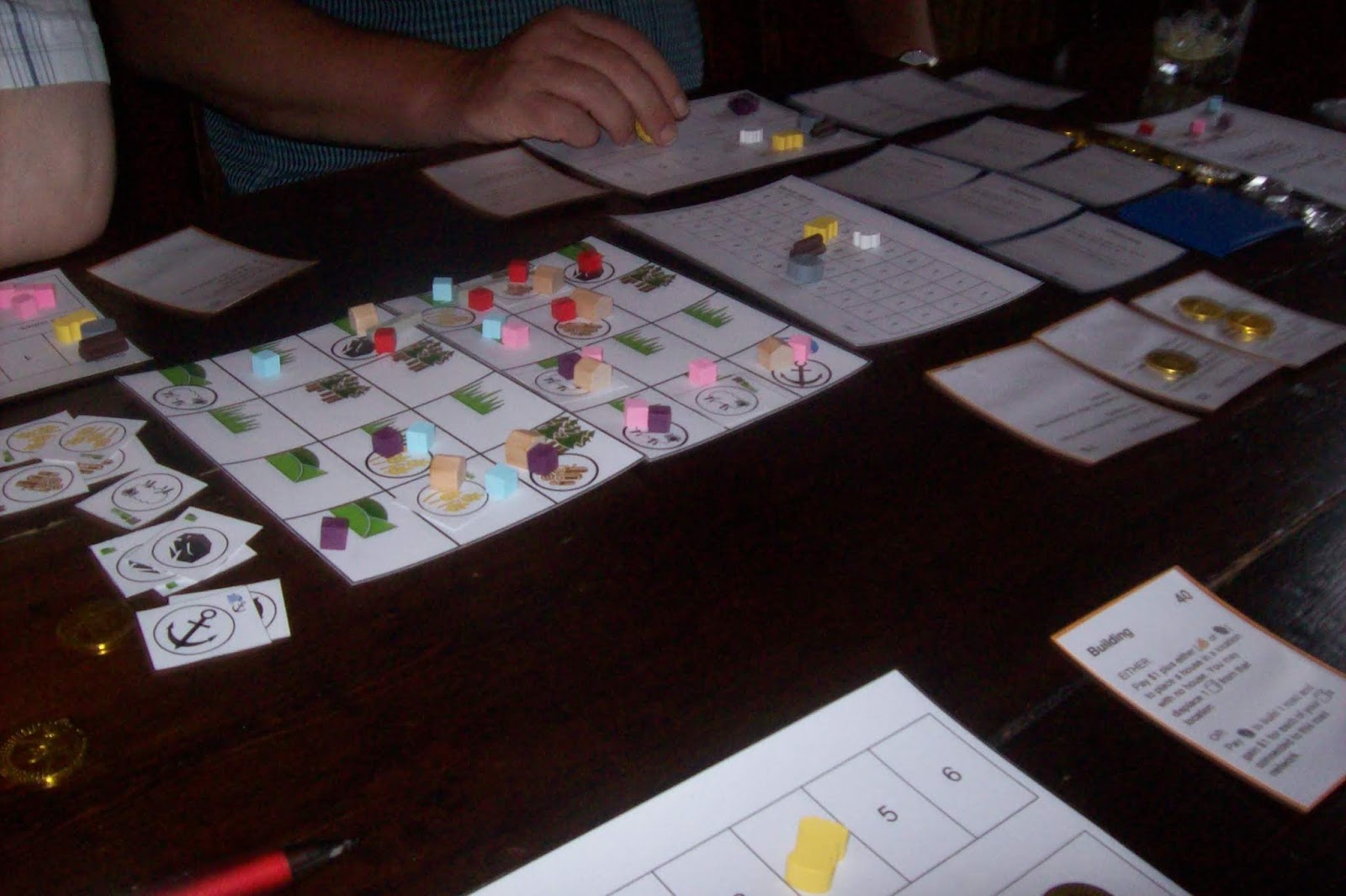
Getting close to the end of the game.
"What's that you've got there, Grandad?" asks one of the players,
spotting that I am using an old camera rather than my phone.
So, what did I learn? Well, the objective cards are still well out of line, but this is not news -- I haven't actually changed them in the last couple of iterations. More specifically, though, there is currently a class of objective where you just need to have a particular board state (like have roads connecting certain features), and this sat poorly with the players, who all wanted to see objectives that they achieved themselves.

I got some interesting feedback on the market very quickly, and all three of my testers objected to how it worked. The idea is that there is a marker for each good on a number track, and when you buy a good, you pay the amount to the left of the marker, and then move the marker left, which usually increases the value of that good.  Selling works the same, but moving to the right, lowering the value.  The feedback I received was that this seemed unintuitive, and the price should just be the value that the marker is on, and then the marker should adjust accordingly.

This is an odd one, as the players were unanimous in this opinion, and they are clearly correct in their opinion that they found it unintuitive (a playtester's perception of something is always correct, even if the conclusion they come to is arguable), but I still disagree that their model would be better than the one that exists.  From a thematic point of view I would argue that it makes sense that a merchant would buy something at one price, and sell it at a different (higher) one, and I like this model, so I'll stick with it for a little while longer, but if feedback keeps pointing this way I will get ready to slay this particular darling.  It may well be that I just need to make the chart clearer, and describe the values on either side of the marker as the asking price and the offering price, respectively.  We'll see...

On a related matter, shipping (being able to sell a big bulk of goods at a single, often lower, price than the general market offers) was barely used and seemed to be unincentivised (ick, that's a horrible, jargony word), in part due to one player taking control of the port at the start of the game.  I need to have a think about this (and if it is an action that actually adds to the game), and am considering rolling the shipping action into the same action card as the market trading, as they are thematically related, and reducing the number of cards seems cool to me.  Perhaps a better explanation and graphical presentation may help.

There was also a general feeling that people wanted houses to belong to them, rather than just belonging to the board, as with most of the game elements. I think that this is a pity, as I like the general theme of the kingdom being developed as a whole rather than it being about individual players, but I can see where they are coming from, and I think I will have to at least experiment with this, and we talked through a couple of ideas of how this could work.

The final major point, I think, was one that tallies with feedback from a couple of earlier playtests: choosing an action card should give you a decent bonus for choosing it, along the lines of the classic Puerto Rico. So, for instance, if I choose the market trading action, I might be able to do more trades than you are permitted.

The overall theme of feedback from this session was that many aspects of the game just didn't line up with the expectations of the players.  Is this because I have made poor design decisions and need to get more sensible, or because I am trying something different and interesting, and should persist, and maybe figure out better ways to present these aspects? I'm hoping that it's not entirely the former, but even if it is, then I can learn from that.  I will need to reflect more on this but bear that question in mind as I go through the next stages of development.

In the short term, though, my main priorities are to rework the objective cards pretty much from the ground up and look at the "leader bonus" issue.  I think this will almost certainly result in other changes (for instance, I am having a bit of an urge to make a new board, and there's that house ownership thing...) but I have a focus and we'll just see how things go.

2018-07-19

Action Valley

Previously in the chronicles of Drafty Valley: I made a game where players draft actions each round and most of those actions trigger different variants of drafting mechanics which result in players producing and selling goods and developing land in search of profit.  Testing suggested that most of the game's structure and flow had promise, but the balance was far enough off to get in the way of testing, and some aspects of the game proved overwhelmingly frustrating for some players.

The game has been on the shelf since UK Games Expo, while I thought about other things for a while, but now it's time to have another run at it.

I know the balance of the objectives in the game is terrible at the moment, but I decided to focus on something else for the moment: the core of the game, the action cards. The way the game has worked so far is that each round there is a selection of over-sized cards on display, each allowing an action, including claiming locations, producing resources, and building things. At the start of the round, each player chooses a card, and they get to take the action first, followed by everyone else. At the end of the round, action cards are replenished from a deck.

It feels a bit weird putting a pic before I've explained the context,
but these are the new action cards.
This proved problematic in a few ways, including:
  • I thought it would be interesting for players to discover the available actions as they go along, but this proved almost universally unpopular as players usually want to know what options will come up in the future as a guide for their choices.
  • Some rounds there were poor combinations of actions available, and often players ended up having little or nothing to do on a turn and not much they could have done about it.
  • The random supply of actions sometimes meant that turn order was the most important factor in the game, and sometimes irrelevant, leading to frustration.
  • Many of the available actions were useful at some stage of the game (for some players) but utterly useless at others. More frustration.
So, what I have done is to strip the small deck of action cards back to just seven of them, mostly with options on them, combining multiple former-cards into one.  I have also decided to not bother putting the full rules for each action on the cards, so they are now down to standard card size, meaning that there can be a row of all of the cards visible at once, without requiring an enormous table.

The mechanism for managing action cards is that at the start of the round, each player selects a card, using the "Small World" style mechanism where you drop a coin onto each card that you skip from one end of the row -- we'll say the left.  If you choose a card with coins on, you get to keep those coins.  Cards slide along to the left as gaps appear.  Then, when actions are resolved, the cards return to the right hand end of the row.

This way, every action is available every round, but the actions which were used last round are more expensive, and ignored actions will gradually become more valuable, until someone can't resist the cash payout. 

Which leaves me at a point where I need to playtest again. I've been doing badly at getting prototypes to the table lately, but am working on getting things going again, so it shouldn't be long before this gets in front of other people...

2018-06-04

Back From the Expo

So, another year's UK Games Expo has been and gone, and this time I traveled up the day before it started, thanks to a generous lift from a friend (thanks, Matt!), got checked into my hotel, and then wandered over to the NEC where the set-up was under way.
A view of Hall 1, mid-setup, from the Playtest Zone balcony. 
After a little help on the Cubicle 7 stand and then in the Playtest Zone, I headed back to the hotel, where I stumbled across a group of lovely people who let me play a few games with them for the evening. I seem to manage this with a different group each year, somehow finding a really relaxed and friendly group each time, and it is one of the things that makes this event so special for me. It was also lovely to catch up with these folk at breakfast each morning and occasional other times through the weekend.

On Friday I worked as a volunteer in the Playtest Zone for the morning, then had my first ever "formal" pitch meeting with a publisher in the afternoon, which was terrifying but didn't need to be, as the publisher is an absolutely lovely fellow who was easy to talk to, and was very supportive and interested in what I had to say. The outcome of this was that they won't be publishing Invaded, which is the game I was presenting, but I am welcome to pitch other games in the future, which seems a good result, and I got some very helpful suggestions.

Friday evening included the designer-publisher speed-dating event. There were something like fifteen publishers there, but twenty designers, and twelve time slots for pitches, which sounds like a horrendous mismatch, but it worked out that the designers each ended up seeing nine or ten publishers, with a couple of "break" slots in between, and it was organised so that designers mostly saw publishers that were more likely to be interested in their games. For instance, I didn't get to see the publisher of party games, who definitely wouldn't have been interested in Invaded.

By Saturday morning, after a couple of exchanges of emails based on meetings at the speed-dating, one publisher had asked for a copy of the prototype (I had a spare copy so was able to accommodate that) and another had asked for a meeting to try actually playing Invaded.

After my Saturday morning spell of volunteering I was able to quickly eat a sandwich before meeting with the publisher who wanted to play Invaded. We found a table and had a full, three-player game that demonstrated well some of the features of the game, but fell flat overall (quickly make some notes about what went wrong -- mostly that the game went too quickly and was entirely peaceful). This publisher was very interested if the issues that showed up could be addressed, and gave some really useful feedback.

Drafty Valley in play. Hand modelling by Jen.
Continuing another busy day I got back to the Playtest Zone in time for a testing slot of my own, running a play of Drafty Valley. This being something of a prime time, I hadn't even finished setting up when I had two players asking to play, and we were just starting off when another two turned up, so we reset and got going with a four player game.

So the headline news was that the game was horribly broken. One player in particular seemed to be  getting a bit frustrated by the imbalances between the action options and the objectives. I need to do a massive reworking of the game before another playtest, but I have a list of points to address and some ideas on how to progress, so I can work with that over the next week or two.

Alongside the problems that were identified, there was something totally awesome. I managed to explain the game in about five minutes, and then stepped back and managed to watch the players play the game on their own, with only a few clarifications and corrections needed here and there. I don't think I have ever spoken less during a playtest. This was an amazing feeling, and I'm holding onto that bit of win with both hands.

Saturday was rounded off with an actual sit-down dinner with some friends (some old, some new) followed by a great session of gaming (some published games, some prototypes).

On Sunday morning I had another playtesting session booked, which I had been intending to use for Drafty Valley, but given the previous day's test I felt I would not gain very much by playing that again before an overhaul, so on a whim I pulled out Boogie Knights, to take a fresh look at that.

The knights seem quite fighty at the moment, but there's that tutu...

We managed to play three games of Boogie Knights (twice with three players and once with four) in the ninety minute slot, and managed to get a good amount of feedback and insight in that time. The biggest problem at the moment is that the balance of equipment and challenge cards can be uneven, and particularly late in the game in three player games (less so with four, but it's still there) it can be frustrating to have too many equipment cards and not enough challenges.

Based on some of these discussions I am now thinking about ways to change the game to include multi-use cards (cards that work for both equipment and challenges, for instance). This would be a dramatic change to the game, but if I can figure this out it might just work. I have a couple of ideas...

The rest of Sunday was largely spent perusing the stalls around the two enormous convention halls with my wife and daughter, who had come up for the last day of the event, as they have done for the last few years. And then it was all over.

So, I've finally put my toe in the water as far as having meetings with publishers is concerned, and survived the crucible of the speed-dating. I probably wouldn't do the speed-dating again, but it was a valuable experience and helped get some dialogues going. Overall, I now feel a lot more confident about talking with publishers about my games, so will be sure to do more of that in the future. As always, the experience of being involved in the Playtest Zone was really rewarding, being an opportunity to meet and hang out with game designers ranging from first-timers to highly experienced, published veterans, who make up a great community.

Now I need to catch up on sleep, and get to work on implementing the changes I need to make to various games...

2018-05-21

Jugged Valley

This weekend was time for another trip to London for playtesting, and I took with me my game which currently has the most momentum, Drafty Valley (for which I would like to find a new name!).

Now I've written that last sentence, I find myself thinking about momentum. It does seem to be that games vary in how much progress they are making at a given time, and that often, a game that has had some focus will keep moving onwards, with the occasional nudge from me to keep things going, until friction takes over and things grind to a halt. Earlier this year Craghold and Scurvy Crew were moving forward well. This time last year it was Invaded that was developing freely and quickly. Right now it is Drafty Valley.  The metaphor breaks down a little because usually a project seems to get moving on its own (specifically, I wake up one morning with an idea to try with a game, and it goes from there), but once it's moving, it keeps moving for a while. I'm not sure if my going-with-the-flow approach to game development is a particularly sensible one, but at least I do feel that I am making progress most of the time. Is that enough...?

Turns out that developing a location can get a little fiddly when there is a load of stuff on the board.

Anyway, back to the meetup. As planned, I left the prototype unchanged from the test I did at the Oxford meetup a few weeks ago (having not had a playtesting opportunity for the game in the meantime) and I played with the same rules, not changing setup, though happily I was able to get a 4-player game this time.

The first thing I noticed was that I got a lot of pushback (from one player in particular) against the idea of only explaining the parts of the game in the initial setup and allowing players to discover the game as they go. This doesn't really surprise me, as a lot of players do want to be competitive on their first play and want to know everything up front. I don't think this is really a problem: the game can be learnt in two ways: either with a short explanation and then find out the rest later, or by explaining everything up front. I think I'll keep things as they are and then I can use both approaches as fits the situation.

The game went well overall, though ran longer than I was hoping. We cut play off after an hour, with maybe ten or fifteen minutes left to go by my judgement.  Still, the players generally approved of the style of the game and the way it flowed.

That being said, there were, of course, problems.

What I think was the main issue was that the objectives didn't work right. The idea is that a pick-and-pass draft of objective cards (like in 7 Wonders or Sushi Go) takes place in fits and starts across the game and, while it worked a lot better than it did last month, it still left players waiting for information about what they should be trying to do in the game, and felt frustrating, and also (unlike the other actions) offered no advantage to the player who chooses the action card. A few ideas were thrown around, including possibly starting the game by getting everyone to draft a set of objectives, which could work but often makes for a horrible experience for inexperienced players. What I think I will try is to sacrifice a bit more table space by having a set of objectives on display, and then the "select objectives" action would involve taking cards from that display.  I may even go a little further and deal everyone a random card at the game start.

The other main issue that I want to consider this time is that the variability of which action cards are on display means that sometimes a player has first pick for that round, but there isn't really anything that they care greatly about, but other times a first choice is massively powerful.  This may be a little harder to fix, but I think that the solution is to make sure that every action is sufficiently interesting, or provides a really nice benefit to acting first with them (the actions resolve with whoever claimed the card going first). I will have to ponder on this one for a while...

So, that's what I will be doing in my spare time this week. I have decided that I will be taking Drafty Valley to test at the Playtest Zone at UK Games Expo in less than two weeks' time, so I need to deal with the biggest problems in the game so that I can make the most of the opportunity there.  Quite a bit of work to do...

Apart from my own game, I got to play a couple of others. The first was a football game (or soccer, if you are in the USA!) which isn't a theme that interests me at all, and felt a little fiddly, but had some really clever elements to it, so I suspect this will turn into something really cool for the right type of players.  The other game was a very early version of an experiment trying to make an accessible trivia-quiz game with a hidden traitor element; this wasn't really working, but led to some really interesting discussion, so it will be cool to see how things develop here.

2018-04-30

Drafty Meeples

As you probably know, I go to London most months for a Playtest UK meetup, but there is also a monthly session in my nearest large town, Oxford. The events being on Sunday evenings tends to make them less convenient for me, but I've made a few of these over the last couple of years, and this week I managed another.

Unfortunately this session had only four of us in attendance, but with a little negotiation and planning, all of us managed to get one of our games played -- though one was a longer game and we only managed a partial run of that.

I forgot to take a photo of my game in play, so here's a pic of a 4-player setup at home.
I had a two-player game of Drafty Valley (which will need a new name at some time), which was enough to give a reasonable test of the changes I made since its last trip to the table.  The game ran for about 45 minutes, starting with a very short explanation of just the rules active with the initial setup, and learning the rest as they came up, which is my planned teaching method for the game. The first few rounds were a bit slow as the new actions cycled through, but things sped up a lot and after the first time through the action deck the game was flying along nicely.  We even ended up with a nice, fairly tense ending, which was pleasing -- though probably more by luck than design.

Overall the changes I made seem to have moved the game in a positive direction, but the game start is still a little slow in terms of getting things on the board. This was actually feedback I got from the previous playtest, but I didn't really address this time. I think that next time I might have everyone starting with a control cube on the board, which should accelerate the early stages quite a lot.  Other than that, I'm planning to run at least my next playtest with the same prototype and hopefully see how it looks with more than two players.

Incidentally, the paper-thin theme on the game and the general "get resources and swap them for money or more resource production" makes the game perilously close to the Eurogame cliché of "trading in the Mediterranean", but at this stage of my game design career, maybe that's not necessarily a bad thing. I've been explaining that the conceit of the game is that players are businessfolk in a corner of the kingdom, getting contracts from outside to develop the land in various ways, and that the objective is to fulfill certain key contracts and make as much money as you can while you do so, and that seems to fit just fine right now. Maybe I'll be able to come up with a more interesting thematic justification for everything later, but for now I'll just let it ride.

Other than Drafty Valley, I got to play a couple of others... One was ostensibly about investment and market manipulation, but is actually focused on negotiation, and does that very well once you get into it, and shows great potential, even though it's not a style of game I get on well with.  The other was an ambitious cooperative game about defending a village against ravaging monsters; the concept is great and the designer has made some absolutely charming character illustrations, but at the moment the gameplay seems a bit fiddly compared to what the game seems to want to be; if the designer can find his way through the complexities, this could end up being really great fun.

2018-04-17

It's Drafty in Victoria

After missing last month's playtesting meetup in London, I actually made it this weekend, and on a whim decided to take my hand-made and still unplayed (other than some solo plays) prototype of "Drafty Valley".  I was chatting with one of the other designers before the session started, and we agreed that the type of feedback gained from other designers at this sort of meetup can often be amazingly useful in the earlier stages of a design, but might be less productive later on. That's been my experience anyway.

I was selected for the first round of games, and quickly had three volunteers to join me for a four-player game. Pleasingly, they were all willing to go with my preferred approach of, "We'll just explain each new thing as it turns up," and the game started in what must be a record time.

A few rounds in and there haven't been any builds yet. Hmm...
I won't go into a play-by-play or anything, but will report that many aspects of the game were just horrible. For instance:

  • Several actions just didn't take place because people couldn't capitalise on the selected cards.
  • The players producing grain and sheep found that there was precious little to do with their resources.
  • It took ages before we were really interacting on the board, and even then a couple of the players were still pretty isolated.
  • The scoring cards seemed pretty random and poorly thought through (well, there may have been a reason for that...!) and not knowing what was on them at the start of the game left players with no real direction for the first couple of rounds. 
  • The benefits of buying and selling on the market were massively disproportionate compared with the other things you could do.
And so on.

However, I knew that the game was shonky when I set out.  What I was really wanting to test was the overall concept of mashing together several variants on a drafting mechanic (where players pick some sort of a resource from a pool, generally taking turns to do so), and with the activities on each turn also based on drafting from a pool of options. How did that general idea work?

Well, towards the end of the session, one of the players said something along the lines of, "I don't know why we're doing what we're doing, but what we're doing is fun." He, and the others, had a lot of criticisms about the details of the game (as above), but the consensus seemed to be that the overall shape of the game (if not its current dynamic arc) has potential.  I am more than happy to take this as a result for a playtest.

So I need to build a new prototype which fits together a little more coherently, is not as slack at the beginning, is less likely to leave players unable to act on their turn, and gives everyone a bit more of a clue about what to do early on. All this while avoiding adding extra elements as, while I have a number of ideas for more features that I would love to add, there is probably enough here already to make a decent game once it is all knocked into shape. It would be great if I could get this one to play in, say, 30 to 40 minutes, but we'll see how we go.


Aside from my own game, I got to play two prototypes from other people. One was a midweight Euro with some really interesting challenges; it was a bit fiddly, and the various subgames weren't quite in sync with each other, but I really enjoyed playing it and can't wait to see it finished. The other game was a really neat and colourful abstract game that was teetering between being a crunchy puzzle-strategy game and a semi-mass-market family game, which I also very much enjoyed playing.

2018-04-06

Building in the Valley

Following on from my post about my "drafting" game a couple of weeks back, I have spent a little more time on the game and am getting closer to a complete game.  There's still a little way to go, but it's coming along.

This game has been developing along an interesting path. What I did was to start with enough components to just about play a first round with three players, and solo-played all three positions myself, adding extra components when I needed them.  Unusually, by my recent standards, I was working by drawing on bits of card, something I usually only do for initial experiments with small parts of a possible game.
The big, green pawn, by the way, is a first player token.
This is a method that works pretty well with a supply of index cards, sharpies, scissors and a paper trimmer, and assorted "stock" components. The game starts with five actions available (claim location, produce goods, sell goods, buy goods, and select score cards), so the game can pretty much be started with knowledge of what those actions do, and more introduced as they are added from the deck, including the opportunity to build locations and roads, and expand your control from claimed locations.  Some of these required additional components to be added, and I was making new action cards when I thought of them.

At this point, the only thing really preventing the game being playable all the way through is a lack of score cards (I just fluffed through that when it came up), and I'll need to throw something together there before I can get much further.  The idea is that when the "select score cards" action is chosen, everyone gets to select a single score card which gives them a scoring condition to apply at the end of the game. Each player will acquire maybe three of these through the game, and not all of them will be in play in any given game. The idea is that your strategy is shaped by the score cards selected as the game progresses.

One major decision (which is reversible if I don't like the outcome, so it's not really a big deal) is whether victory is based on how much money you have at the end of the game (in which case the score cards give you bonuses to your earnings), there is a victory point tally, or something else is used. Victory points seems natural to me as a gamer, but they can be unintuitive and seem very arbitrary, suggesting that it is usually better to have some other measure of success.  I'll probably plump for "have the most cash" as the victory condition to start with.

Anyway, that's where we are at right now. Once I have an initial set of score cards I'll start pushing the game at playtesters, starting with some who I know are OK with incomplete and terrible games.

2018-03-19

A Change of Plans: Wind, Snow, and Drafts

This weekend I had planned to take a trip to London for a Playtest UK meetup, as is my wont, but our more-wintery-than-usual winter came back and did its thing, so I decided that it would be more sensible to stay at home for the day than risk the roads. So that was a general scuppering that I would have been happier with, but I did get the opportunity to spend a chunk of the afternoon discussing various projects (via a Google hangout) with a friend had also been planning to go playtesting and had opted to stay warm and safe for the day.

Anyway, this friend and I had previously discussed the possibility of designing games based on multiple types of drafting mechanics.  Drafting is basically where players select resources from a shared pool, and this can take many forms like the system we used to have at primary school for picking teams where each team captain took it in turn to choose one player from those so far unselected (I was invariably in the last few chosen), or a "pick and pass" system where players simultaneously choose a card from a selection they hold, and then pass the rest to the next player. There are many other mechanisms that could be broadly described as drafting.
As I keep telling people: stop thinking about making a game, and just make a damn prototype,
even if it is not a complete one. Sometimes I do take my own advice!

After a load of chat about this type of mechanism, we each had an idea for a game that could exploit the multiple draft concept. If either of these games comes to anything in the future, I think we can be clear that they were "mechanic first" designs, in case anyone asks.

My idea was based on the not-massively-exciting concept of settling and developing an area of land, building production facilities and exploiting them for profit.  Each round would consist some event or action that would allow for a different variant of drafting to resolve. In other words, each round there is something to distribute between the players, and that distribution is done in assorted ways.

I made a load of notes about this after our original discussion (and we kept the discussion going online for a little while) but I moved on to other things before I actually built a prototype.

Our discussions again this weekend did a good job of reminding me of this project and set me off again. A short while with some index cards, Sharpies, and assorted components from stock, and I had the beginnings of a prototype. It's not yet enough to play, but once I start handling physical components, new questions and answers start presenting themselves, and I start needing to make decisions which will inform how the game will develop.  Like, for instance, how do I handle resources? There are many ways to do this, but I have decided to use a short track on individual player boards to mark the quantities of each commodity held by each player rather than, for example, having tokens to represent quantities.

I don't quite have enough made to allow me to play a full round of the game, but I know what I need to do next, so once I've finished blogging about it, I'll get back to construction for a couple of evenings, and solo test parts as I am able.

Kinda related, Toucan Play That Game recently shared a good video of a panel at the recent Airecon on how to teach games to people. Paul Grogan (of Gaming Rules!) talked about the method the CGE team use for demonstrating their games at conventions by explaining just enough to get going and revealing the rest of the rules as it makes sense during play. This may be terrible if you want to construct and execute a winning strategy on your first play, but it can be a great way to learn the game.  Similarly, last year, a friend and I played our way through the card game, Fast Forward: Fortress, which doesn't has a rulebook but instead gradually reveals the rules as you work your way through the deck over the course of a dozen plays. This works well and we really enjoyed playing that. 

The reason I bring that up is that my drafting game now looks like it will involve a series of rounds, during which, players each choose one of a selection of available event cards.  These events then trigger the main actions of the game, so one gives everyone an opportunity to build production locations, another allows locations to produce goods, and another allows everyone to sell to the market.  Because of this, it looks like the game will be playable by simply explaining each of the events revealed in each round as they come up, and learning the game could be an organic experience where play can start almost immediately after sitting down for the first time.  I rather like that and hope I can pull it off.