Showing posts with label playtesting. Show all posts

2026-06-07

It's an expo, it's about games, it's in the UK

Another UK Games Expo has come and gone, and if you are paying attention to analogue games news, you may well have seen the numbers, which are significantly up from last year, and almost double the pre-Covid peak attendance. The event now occupies all five of the main halls (though with some unused space in some of them) around the NEC's central piazza space as well as a load of smaller rooms and a significant portion of the nearby Hilton hotel. It's not the biggest event of its type in the world, but it is flipping huge. I played only a handful of games (all on Friday night as it happens), but that isn't the point for me...

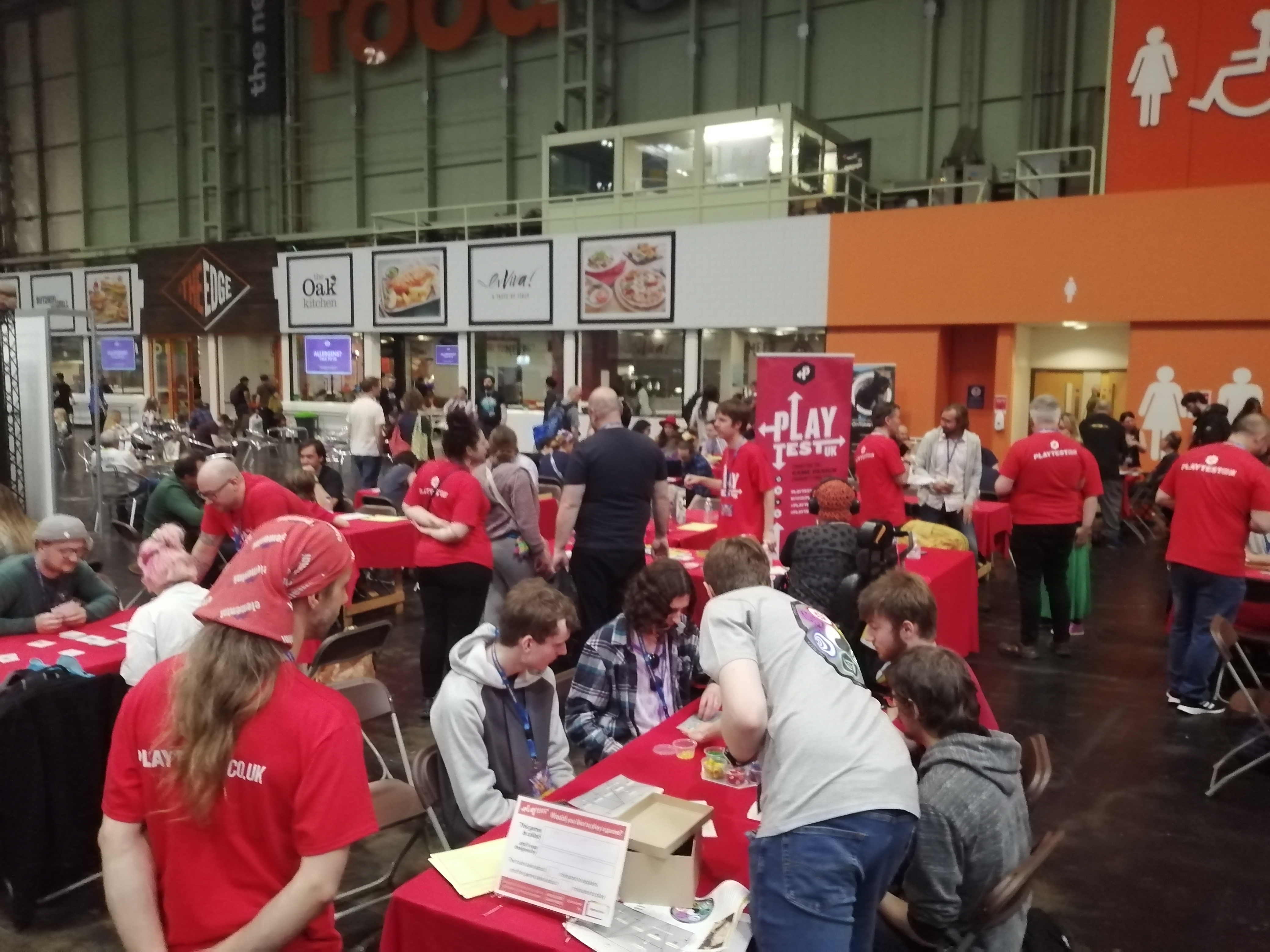
As has been the case for the last few years, my involvement in Expo has centred on the Playtest Zone, which was in the same spot as it was last year, which is a great little area at the side of hall 2, alongside a load of stalls related to university game design programmes and the Panda GM area that provides spaces for ad hoc meetings to anyone who needs them, which is a great facility to have.

The Playtest Zone in full flow.

There were over 200 game designers with us over the three days of the show, with a huge variety of games, the prototypes varying from shiny, professionally printed ones, all the way down to cards hand-drawn in pencil. I can tell you that I have a real soft spot for the games that are closer to the basic end of that continuum. Unfortunately I didn't get to play any of the games, but the buzz around the place was amazing.

For big chunks of time, we actually had a queue of players wanting to test something, and they stood incredibly patiently for spaces to become available. It's a wonderful thing to see how many people want to play unpublished games, and how many come over specifically for the experience. And hanging out with such a wide range of game designers and other folks (especially the other volunteers) is always a pleasure and a privilege.

Time for a little rant, though... Every year we have a few designers (or even publishers) booking playtesting slots, where it is clear that their objective is to promote their crowdfunding project. The most egregious one of these I spotted this time was a very nice crew who finished their spot and as they were packing up I asked (as I often do) how things went and whether they had useful feedback. Their answer was that it was great, but they weren't looking for feedback because the game was done. I stepped away at that point and did some breathing exercises.

So what? Well, the objective of the playtest zone is to enable designers of all levels of experience to get feedback from "normal" gamers, while also providing something fun and interesting for those gamers. We explicitly aren't there to provide a free demo table for publishers. We don't really have the ability to stop this sort of stuff happening, but if you are reading this and are someone who is looking to promote your game, please know that I understand how hard it is to build up a buzz around your game and you just want to take opportunities, but you are preventing another designer having an opportunity.

Note: I am just a regular volunteer and opinions expressed here are my own and do not necessarily reflect those of anyone who organises anything or is in any position of authority.

Magical Artifacts around the middle of the game.

Back on the main plotline, I had a playtesting slot, and this time it was Magical Artifacts, which was played by a group who had played some of my games in previous years (thanks folks!) and threw themselves right into the game. Unfortunately we didn't quite get to complete the game in the allotted time (an hour of play for four players and we had a couple of rounds left to go), but I got some useful notes. The key stuff is still to find ways to make some rules explanations clearer, and probably to tighten up cost and benefit balance a bit.

Something else I'd like to mention is the Indie Market, organised by the lovely folk who organise the Bastion convention that I have been to a few times in North Wales. This was a room with some 15 or 16 designers selling small print run games for a couple of hours, and this had a huge queue of those of us who wanted to buy stuff, which meant big delays to get into the room. It seemed to be a huge success overall, and I understand the Expo organisers are planning to allocate more space to this for next year. 

It has basically taken me a week to get myself into a state where I can think about or do anything much, but now I'm back, and I'm still buzzing about the amazing vibes from the event. I'm looking forward to next year already.

An ironic sign at the Hilton. To be fair, this was at the bar,
while they had a huge amount of other space for folk to play in.


2026-03-31

Introducing The Artificers...

Oh good grief, it has been a long time since I wrote a blog post. I haven't stopped working on games, so let's catch up on one of the projects I have on the go...

So, The Artifact, the game I have been working on, mostly online, with Alex Cannon for quite a while now that has been through a good few iterations based around a core mechanism that is pretty much unchanged since the early days. Last year we had a really interesting playtest with someone who happened to be part of a game publisher. They gave some really interesting suggestions (being very careful to stress that this was not advice on how to get them to publish it) which we thought about, and then decided to run with to see where it would take us.

The first physical playtest of the new version, with hand-made cards because
muppet here had forgotten to bring the cards he printed and cut out the day before.

One of the biggest points was that all the way through our work, we had clung to a concept of the game being effectively a race to complete a certain number of objectives (though more recent iterations involved a sort of tic-tac-toe element on top); the advice was to try turning it into a more standard victory point game. This basically involved killing one of our darlings, but we thought, why not? If we couldn't make this work properly, we could always roll back to what we had before.

The other key suggestion was to move away from our initial setting, which was about exploiting alien technologies, and go with something more "boring". This may seem counter-intuitive, but I think the overall thrust was that the core mechanism (the way resources are accessed and exploited) seems reasonably novel, so fitting that into a more vanilla fiction and mechanical structure would be more comfortable to a lot of players - and, to be honest, it would probably work out being easier for us to actually finish.

And so, we now have a pretty generic fantasy setting, where players are building a series of artifacts, making use of magical resources that their assistants are collecting from around the land, with the artifacts being built providing various combinations of special abilities and victory points. The title, The Artifact, just doesn't seem right any more, so I've taken to calling the game The Artificers - though maybe better would be something like, Artificers of Ambivalencia...?

After some online development, Alex and I finally got a physical prototype built and met up to test it - we live a few hours apart, so this sadly doesn't happen often. A first play-through went OK, so we then concentrated on playing through the first few turns of the game a few times in a row, trying different setup options and seeing what would happen if all the random elements conspired to make things as frustrating as possible. It took a couple of rule tweaks until we were happy that things looked pretty solid, but obviously this was just with the two of us playing.

Another playtest: this time, four players, none of whom were me!

I've had a couple of playtests so far since then and it's looking promising so far. The previous major version of the game was usually taking something like half an hour to play in physical form, but we're now looking more like an hour, which actually seems appropriate for the weight and style of the game. 

So it seems we have a solid direction of travel here, and we have actually started talking about game balance, which is something that neither of us usually spend too much time on, and we think this might mean that the game is finally getting to a pretty mature state. Obviously a load more testing is required...

2025-11-30

Ice Creams and Meet of Dragons

This weekend was Dragonmeet, the one-day tabletop games convention in London, which had moved from its previous home in Hammersmith to the ExCel exhibition centre in the docklands area. As a result, the event now has a very different feel, moving from various function rooms in a hotel to a big hall and some attached seminar rooms. I didn't get involved with seminars or roleplaying games that were taking place out of the main hall, so can't comment on those, but the trade hall felt like a smaller, more easygoing version of the UK Games Expo halls, with more smaller traders and a lot less difference between the large and small exhibitors, which felt good to me. There were also some good options for getting food and drinks in the main concourse of the venue, which beat the previous location, where you had a choice of the hotel catering or leaving the venue.

Anyway, as usual, I was helping with the Playtest UK area, which had four tables in the corner of the main hall, which was much better positioning than last year, and things went really well. The day was split into four two-hour time slots for each of the tables, so that allowed sixteen designers to get their games tested, all of which seemed to go pretty smoothly. I even got to run some tests of a game I'm working on.

Ice Cream Chaos with a lot of dice.

The game this time is a new project collaborating again with Mike Harrison-Wood, the co-designer of Grab Bag: Jungle (pre-Christmas plug here: great family fun game, available now!). This one has the working title of Ice Cream Chaos and involves dexterity (chucking dice at targets), a good wadge of luck, and a little tactical thinking. It's still in the early stages, but we have a working prototype (actually we each have one, with some differences between them) and have been starting to test around the place. Fortunately, it just takes about ten minutes to play (and not long to explain), so it's easy to get to the table, but unfortunately (maybe?) it's another game that relies very much on the physicality of the game, so we can't meaningfully test it online. 

Anyway, the test was very useful, yielded some helpful feedback and criticism, and generally went down well with the testers, who were pretty positive about it. I was most pleased to talk to a twelve-year-old kid (with his dad, the closest thing to a target audience we have) who gave it a go and was really enthusiastic and had some helpful thoughts for us.

So, we have some momentum on this one. The core of the game works really well, but as is often the case, the devil is in the detail. Hopefully we'll get a good bit more testing over Christmas, trying out a few variations, and we'll see where that gets us.

2025-09-29

On Mighty Monarchs and Glass Cannons

My work-in-progress, called The Castle War for now, is a 2-player card game that could be described as a "lane battler", where forces line up at 6 locations (castles, natch), vying for dominance. It's based on the 12th century war in England between King Stephen and the Empress Matilda and, while it isn't a historically faithful game, it does take a lot of cues from the history.

One point gives a little asymmetry between the sides. Matilda didn't take a direct part in most military operations, while Stephen did his kingly duty of personally leading troops, something that cost him his liberty at one point, though this game is not about that specifically. Matilda's player has a special ability which takes a little work to activate, when this has been done, she gets a little extra control over movement and activity restrictions. On the other side, Stephen is represented by a card that can provide big bonuses in combat, but if a conflict that he is directly involved in is lost, his player loses the game instantly due to his capture.

King Stephen is at a Devizes Castle, having been revealed in a previous turn.

This makes the Stephen card powerful but vulnerable, and there is a possible "fool's mate" type situation that can happen very early in the game - plausibly on turn 2. The situation is as follows:

The Matilda player goes first (they always do!) and play a couple of cards to a castle. Most turns involve playing one or two cards from hand, usually face-down to line up at castles.

The Stephen player plays the King Stephen card plus a military unit card.

The Matilda player chooses to trigger the conflict at that castle, so all cards there are revealed. Matilda has a unit and one of Stephen's loyal leaders on their side, which means that the leader is ransomed: Stephen takes the leader into hand and Matilda takes one of her foes cards from the castle; she is not permitted to take Stephen, so takes the unit, leaving King Stephen unprotected. Matilda wins the conflict and as Stephen was there at the time, wins the game outright.

Since it became part of the game, I have enjoyed the powerful-but-risky nature of the King Stephen card and have been resisting watering it down, feeling that it is a strong feature of the game. However, on a couple of occasions, playtest feedback has pushed for a change after an early disaster happened. I believe a lot of players of this sort of game enjoy the tightrope walk, but it is clear that some players who are tripped up early are certain to have bad feelings and never give the game a second chance.

I was discussing this with a game designer friend who has played the game quite a few times, and it felt like I might have to just give up on my preferred rules, when inspiration came, which I think was partly shaped by a rule in the friend's game that we had played earlier. The solution was that, while originally the King Stephen card started in his player's initial hand of cards, it could start on the table and out of play, and taken into hand on the first occasion the Stephen player has to draw cards. From then on, the game just proceeds as before.

The down side to this is that the Stephen player needs to remember to pick up the card at the appropriate time, but this can be reinforced on the player aid and on the card itself, and I think is acceptable in this style of game. The up side is that we still have the fragility I like, but players are likely to have seen 1 or 2 conflict resolutions (they happen whenever a player takes their turn to refill their hand) and a good number of different cards before King Stephen can be put at risk, meaning that even new players will have a better idea about how everything works.

It's still early days with this rule, but playtesting so far suggests it works OK. 

2025-08-30

Meetups and Resurrections

I've not been going regularly to playtest meetups since before Covid - I've been to a handful, but that's in comparison to generally about one a month beforehand. But then the lovely Naomi and Callum, designers of Platypus, and friends and helpers at the UKGE Playtest Zone, decided to reestablish the Oxford meetup at a pub around the edge of the city, a location that is much easier to get to for an out-of-towner like me than the city centre would be. 

So we've had two meetings so far, taking place on the last Wednesday of each month. The meetups are a bit shorter than other ones I have been to, with the structure so far being two slots of an hour or so each. We have so far been fortunate to have several attendees each time who hadn't brought games and just wanted to play, which makes it far easier to make sure everyone who did bring a game can get it tested.

Bits of three prototypes: Boogie Knights, Reign of Terror, and My Name Is...

I've been on a bit of a run of trying out old, shelved projects, as I was musing back in my post in April. I have tried out two of the games mentioned in that post and one other, so I think I'm doing OK on that front. The aim of the tests was what one of the other designers described as a "vibe check", it was kinda like throwing part-cooked spaghetti at a window to see what sticks. 

Reign of Terror is a game that I threw together long ago as a possible party favour at a French Revolution themed event, and is a hidden role game where multiple players can win or lose according to their individual role. I playtested and revised it a couple of times, but I didn't persist long enough to get to a place I was happy with. The game worked OK in this test; the players enjoyed it overall, but some elements were unclear or inconsistent, and it was a bit frustrating in places. The concept was a hit and the flow of the game was good, so maybe if I can tidy up the messy bits, it could become something to take further. It does have the disadvantage of four players being the minimum count for a decent game, so that's a limitation for testing and potential pitching.

My Name Is... is about memory and mental agility and I am truly terrible at playing it. The game is great at inducing both pain and laughter, sometimes simultaneously, but has a potential issue with timid players - if nobody is brave enough to challenge other players over their mistakes, nothing happens in the game. In its current state, tracking what cards people have in their stacks can be a big issue too - though with more players (we had only three, which I think is the minimum) that is likely to be less, though there would be other challenges coming into play. All in all, this feels like it is one or two small rule changes away from being "done", but I don't really have inspiration. Maybe this is one I should talk to one of my game designer friends about possibly turning it into a co-design.

This week I got Boogie Knights out. This is the first game I ever took to a specific playtesting event, and I have a real soft spot for it, though that may be a problem, preventing me from either letting go of it or making a dramatic change. Shockingly, it has been seven years since the last revision I made to the game, so this fresh look was long overdue. The game has, practically from the start, been enjoyed by players in general, but has just been a bit hollow, with actions being frustratingly unavailable, periods of play being repetitive, an unexciting endgame, or any number of other flaws at different stages of development. My players this time played the game in the spirit that is intended (it's pretty much a family game with gentler conflict than you might imagine), found that the game is basically OK (as usual - engagement was good) but the discussion afterwards came up with a whole lot of potential avenues to explore.

All in all, I think I will be spending some time on Boogie Knights and seeing if I can address its current flaws. I mean, I'm seven years older, and a load more experienced, so maybe the game has a chance...

2024-12-24

Jams and Playtesting

A couple of weekends back, I was lucky to be invited to a board game designers' weekend. It was just a small event, held in a private house, with a dozen or so designers attending, with varying levels of experience, design styles and interests. I had been to one of these previously and had a great time, and this one, with a different mix of people, was just as enjoyable and useful, but with a different feel to it.

Most of the time was spent playtesting each other's games, with the aim being to ensure that everyone had reasonably even opportunities to test the games that they had brought. I was able to get tests of both The Artifact and Squirrelled Away, with really helpful feedback and observations from both, meaning I had a fair bit to talk about with the respective co-designers afterwards.

Apart from the playtesting, there was an hour or two spent on lightning game jam exercises after lunch each day. The objective was to team up with someone and create or develop game ideas according to the rules being used that day.

A game from the Sunday jam. When working
this quickly, rough and ready is the thing.

The first day had us splitting into teams of two and then going through a series of short (about 10 to 15 minutes) spells of development. The first period involved setting some constraints for a game design. Then these constraints were passed to the next team, who had to begin a game design based on these restrictions. After this period, the projects were passed on to the next team to continue the development and so on. Having gone through a few iterations of this, we had a little "show and tell" session where each team discussed the game that they had ended up with.

On the Sunday, things ran a bit differently. There was a table of components available, and everyone chose a batch of those components (maybe a handful of dice, some plastic rods, or a bag of feathers), and then find a partner who has some other components, and then create a game using the combination of components in 15 minutes. We went through four iterations of this, and I was delighted to have created four actually playable games (mostly terrible, obviously, but one was quite a lot of fun) with four different design partners. The debrief session from this was just a general group chat about anything we felt was interesting.

Overall this was a great weekend that completely wiped me out, but left me with so many ideas buzzing around and a great feeling from working with a whole bunch of other people, who all brought their own skills and personality to the process. The high intensity game jams were excellent practice in both working with other designers and in quickly sketching ideas. During the second jam in particular, it felt great to get an idea to the table and start the testing process so quickly. One of the games actually went through some iteration as we got the initial game to the table within about 2 minutes of sitting down.

So, if you are a game designer, and you get the chance to attend an event like this where you can just spend time engaging with and sharing ideas with other designers, I would highly recommend it. If I am invited again, I'll certainly do my best to go along.

This is probably my final post of this year, so I'll just sign off by wishing you a happy Christmas, Yule, or whatever else you might celebrate, even if it is just a day or two off work. I'll see you in 2025, all being well. Have a good one!


2024-07-28

New types of artifice

If you've been here a while, you might remember about The Artifact, a project I have been working on since... ages ago with co-designer Alex Cannon. We've been working on this mostly in a virtual form (implemented on Screentop.gg), and have had a core to the game, about which we have tried a heap of different approaches to make a full game. Some of the iterations have been quick and light, and some have been crunchy brain-burners, but none have really felt right to us.

We got into another fresh approach a couple of months or so back, which felt good. Alex managed to arrange some in-person playtesting which helped develop the idea into something that worked pretty well, and I was able to get some further tests that have added some additional shape to the project. After a period of slow progress, we have got into something of a rhythm with one of us doing some independent testing and development, then working together to consolidate, then the other doing something, and so on...

A recent 2-player test of the game on Screentop.
Note the very basic "it'll do for now" grid on the right -
enough to test with and no more.

It feels to me that we have reached a shape to the game that we enjoy playing and shows promise. It still has plenty of flaws, some of which we have identified already, and some we are sure exist but will need testing to find, but we seem to have a workable direction of travel for now.

The core of the game has always been built around placing domino-like tiles to a central play area, placing "researcher" tokens onto these, and using those researchers to access "knowledge resources" on the tiles to gain... something, generally including "projects" that progress towards victory, but in some iterations there have been other things involved.

Right now, added to the spatial game of building the array of tiles and having researchers in the right place to achieve objectives, we have a secondary board representing the projects and developments that can be achieved using the researchers and the resources they access. This board provides a second spacial element as victory comes from connecting up a group of completed spaces on its grid, and as you complete projects you get actions which can manipulate the state of the tiles, so there is a circular dependency.

A 3-player test that got really bogged down and ground to a stop.

This all works pretty well for two players, but for three, it seems a lot more patchy and the current setup can get bogged down quite badly, with some turns involving some serious puzzling out, and active blocking moves making it very difficult for someone to win. That latter point can certainly be addressed, and we'll have to see if the former is a problem for players. We haven't yet tried more than three players. I think that there are ways around this though, with plenty of elements we can adjust, including costs of projects, layout of the project board, effects that take place with completed projects, and so on. We'll be exploring this over the coming weeks.

We're likely to continue to test primarily with two players for the time being, there being the two of us working on the game, but we'll increasingly have to look at higher player counts. It might be that we can get it to work great for two but struggle with more, and that's fine, but would frankly be a little disappointing. There may need to be variations in setup for different player counts, and this is something we already have some ideas about.

All in all though, progress is good.

2024-03-31

Sympol Numbers

I've had a few tests of my cooperative game, Sympolis, over the last month or so and am now pretty comfortable with the overall shape of the game, but of course, the devil is in the detail and now I am trying to get that devil pinned down. 

So here's the thing: if you make a competitive game, the players provide a lot of the balance; in a cooperative game, the game systems have to do all the work. I'll unpack that a bit. If I want a cooperative game to feel challenging to experienced players as well as newbies, the mechanisms, set-up parameters, etc. need to provide that challenge and have a way to scale and adapt. With a competitive game, an experienced player can usually get more challenge by playing against other experienced players.

One of my traditional blurry photos of a recent playtest of Sympolis.

The last few playtests of Sympolis have all been won by the players fairly easily, with a period of perceived pressure mid-game, followed by that pressure easing off until we reached a relatively straightforward final round that felt more like a victory lap than a finale. The level of that feeling has reduced as I have tweaked settings, but it hasn't gone away. One of the focuses of the game is the pair of "wrath tracks" for each player, which indicates the level of trouble you are getting from the gods and the people of your city respectively. If either track gets too high, your city falls and everyone loses the game. In recent iterations, if the tracks go too low, you gain complications due to the people being too lazy and hubristic, or the gods getting jealous of the pampered people. It turns out that the "high wrath" situation is currently too easily managed, which reduces pressure far too much.

In essence, the game asks players to walk a tightrope, but that tightrope is more of a footbridge, with handrails that look insubstantial, but are actually pretty solid when you test them. 

And that's what I'm trying to deal with now. My usual approach of making games is to just make general guesses about numbers, quantities, and so on, and then revise as I get a feeling for how a game plays out. I think that in this game, I may have got to the limit of how far I can go by doing that - or at least, further progress will be slowed massively unless I adapt.

So that's what I am attempting to do at the moment. I have a spreadsheet page counting up numbers from my main card data source, which is another page in the same document that I use as an input into a nanDECK script in order to build my card decks. This is giving me a decent view on the state of my card decks, but there are things that aren't easy to capture automatically, like figuring out the number of dice that are likely to be required to complete any given challenge card, or even group of cards. 

I think that a potential approach would be to come up with a system to provide a rating for each challenge card, working initially on the expected number of dice needed to complete it, maybe boosting it a bit if there is some complicating factor like requiring precise numbers. In fact, I could extend this and rate the production use of each card also, maybe with production of a die giving 1 point, and provision of some die or card manipulation ability having probably some fraction of a point. Then I should be able to analyse the likely production rating at any given time and compare it with the likely challenge rating on a given turn. Once I have that information I will be better placed to tweak numbers to get the game to the challenge level I am looking for.

2023-12-21

Dragons and Cities and Gods, Oh My!


Cast your mind back to the end of November and the beginning of December, and imagine a game designer who has spent the time since then not getting around to writing about what he did regarding game design that week. OK, scene set.

I actually had two playtests of my cooperative dice allocation game Sympolis over the course of that week: one was virtual, on Screentop.gg, and one physical, at Dragonmeet. 

The first test ended in a loss for the players, with a small chance of a win on the final turn, but that chance really required great dice rolling at that point, which they did not have. There was a sense that another play could have a better result, but also some frustration at some aspects of the game (for example, the players were only able to generate one of the "wild" purple dice each round, due to an unlucky shuffle), and while I am pretty sure there were some decisions that could have improved the situation, the problem was mostly that the players were screwed by bad card draws and dice rolls and not by poor play. Besides that though, the biggest takeaway I had was how energised and proactive the players were: they self-organised quickly, discussing how to solve the problems presented by the game, and while there were frustrations (and not always in a good way), the vibe was really what I want for the game. Now I need to figure out how to bottle that!

I made a few small changes to the game in between, which effectively game a little additional resource and control at the start of the game, partly as one of the biggest problems with the virtual test was due to a dearth of resources (aka dice supply) and vulnerability to bad luck. And then there was a load of printing and cutting of cards to make an actual, physical prototype.

On to Dragonmeet. If you didn't know it, this is a nice, one day convention in London that was traditionally, and is still, largely based around tabletop roleplaying games, though there is a load of board game stuff there, including some great traders and a playtest area organised by Playtest UK - and every time I have been to the event, I have spent most of my time staffing the playtest area (with the exception of last year when there wasn't official playtesting, but a group of us got together and did some anyway).

I failed to take a photograph of play at Dragonmeet, so I faked one here
with some red fabric and components laid out to plausibly represent play.

Anyway, as well as staffing the playtesting area, I had a slot to test one of my games, and I had four great volunteers to test Sympolis. Once again, the players came out of the gates hard. They seemed to get their heads around the challenges pretty quickly and were actively and pretty intensely discussing their options, and we had pretty much the same apparent engagement from the players as in the previous test. Both groups were experienced board gamers, so maybe not fully representative players, but again I am very happy with this. As it turns out, the combination of the changes I made and the different random elements meant that this group won the game with a full round to spare. I think the two groups seemed to be making approximately equally good decisions (though they had different priorities), so it was probably the game setup and play state that made the difference.

A major note in the Dragonmeet play was that none of the players had problems with their wrath tracks, which record problems in the eyes of the gods and populace and provide one of the ways to lose the game. If your wrath tracks are low, it means that you can take bigger risks more confidently in the knowledge that misjudgement at least won't result in the end of the game, and thus you have an easier time of it. I had a useful discussion with one of the players afterwards, and we talked about mechanisms that compensate for things going too well; I have built up a number of elements that can mitigate "bad" luck, but now we have the opposite problem. One thought was that there could be some form of "push back" coming from having low scores on the wrath tracks: if the people are too happy, they get decadent and make bigger demands, for instance. I am pondering ways to approach this, but I like the idea and think it could work well.

One little aside... The current version of the game has a "wrath" card flipped at the end of every round, and these add an additional stressor to the game, which can make things get out of hand if players don't manage them effectively, and these also provide a timer for the game: the last of these cards flipped over means that the game is over. In general, I quite like how these work, but we run into the hoary problem of there being an upkeep action that isn't directly linked in to the game and the players aren't actually motivated to do. In the virtual test, one of the players was very good at being in charge of methodically flipping one of these each time, but in the physical test at Dragonmeet, it got forgotten (and needed reminding) a couple of times, and the rest of the time it was remembered as an afterthought. This is not ideal, and I need to figure out a way to make it so that the game requires the players to flip this card in order to proceed: maybe it actually triggers the gaining of resources, or something. Or, of course, I could find another way to ramp things up through the game: this particular mechanism isn't set in stone.

Aside number 2... With cooperative games there is a common concern about an effect that is often described as the "alpha player" or "quarterback" problem, which is where one player takes control of the game and can sometimes just tell other players what they should do, meaning that less confident players can find themselves just sitting at a table, watching someone else playing the game on their behalf. This seems to me to be a problem with a group dynamic more than anything, but game systems can mitigate this to make it so that an alpha player is less likely to emerge - or even, can't emerge. Examples include having restricted communication, or a real-time element to the game (Magic Maze is an example that has both of these). My inclination at the moment is to just not worry about it for this game. With a good group, it isn't an issue, and the energy at the table from having loose rules that give the players a lot of freedom appears to work well, and I suspect that any attempt to add a mitigation would damage that dynamic I like seeing. That said, I'm now wondering what the game would be like with limited player communication and a strict turn order; it would feel very different, but could be good. I'm staying focused on my current path, but this is a potential alternative for later.

Anyway, I just about managed to get this post in before the end of the year, so I'll wish you a happy Yule, Christmas, New Year, or whatever you celebrate at this time of the year, and all the best for 2024...

2023-08-07

How much wrath is too much wrath?

Probably the biggest problem with making a cooperative game (i.e. one where the players all win or lose as a group, and not individually) is getting the challenge level right. If the game is too difficult, most players will just get frustrated and not bother trying again. If the game is too easy, players just win and don't feel motivated to have another go. 

What we are usually looking for is where defeats feel like a victory was achievable, and victories feel like they were just by the skin of our teeth. And, ideally, we want this to be reliable, so we don't see wild, swingy changes where one time a given group has an easy time, and the next play, with the same initial setup, the same group has a nightmare where the whole thing falls apart in a couple of rounds. Oh, and we need to have varying difficulty levels or alternative scenarios, so that once a group masters the basic game, they have a new challenge to move on to.

We'll not worry about that last point for now, as it seems to me pointless to worry too much about varying scenarios until the basic game is solid but, that said, it's worth keeping an eye open for where opportunities for varying the game come in.

So, just to recap on where we are at here: Sympolis is a cooperative game that I am currently working on, where players are each the leaders of city states, inspired by a mythical view of classical Greece, where they have to deal with various demands from both the gods and the people of the cities. Those demands might be to build a new building, to hold a festival, or to attack one of the neighbouring cities. Fail to deal with the challenges and the gods or the people will get angry. If either of these influences get too angry, or if an attack ends up sacking a city, everyone loses as a neighbouring empire takes advantage of the situation to sweep in and crush the collective culture.

Prototype game components: mostly cards, which show images of buildings and constructions, and assorted other icons and small bits of text. In the middle is a bigger card with score tracks on it with black wooden cubes on, and some of the other cards are partially tucked behind this.
This is what it might look like when you are about to lose the game.

I tend to think of games having a set of "knobs" to twiddle to tune the experience, making it more or less challenging, increasing or decreasing the importance of a subsystem, or whatever. In this game, some of those tuning knobs are the number and proportion of the different types of cards (eg. ones that produce useful resources or abilities vs those that are primarily challenges), the costs of cards, the failure points on the wrath tracks, the details of the "wrath cards" that turn the screw as you play as well as how those cards are added to the game, and so on. There are quite a lot here, maybe too many; like in any complex system, a lot of the elements are interdependent, so tweaking too much at once could have dramatic and unpredictable results.

And thinking of unpredictable results, one of the issues I have with this game currently is at least partially due to there being two independent sources of randomness: cards and dice. This setup feels natural for this game, but there is a big difference between drawing a challenging set of cards and getting the "wrong" dice rolls, and having a game where everything goes right for you. Bad (or good) luck can really compound in a way that can be frustrating for players. Conventional wisdom in game design circles is that, for games that are meant to have strategy or other thoughtful elements, multiple sources of randomness is usually not a good idea. If I am going to keep both sources of random uncertainty in the game, I need to also include ways to mitigate against the bad luck - and maybe even limit the impact of good fortune.

I'm still pondering ways to do this at the moment, and I'm not sure of the correct approach. Right now I'm feeling that I should give the players more tools to allow them to be clever and get around the bad luck, while making the game more consistently punishing. Now, how to twiddle knobs to make that happen...?

One way to address the first part of the equation is with the starting setup. At the moment, each player has a couple of buildings in their cities which produce dice that can be used to deal with challenges. Some of the additional buildings that can be gained allow for dice manipulation, but if these don't turn up, life can be really hard. Maybe the starting selection of buildings given to players could include some dice manipulation options, so some of that flexibility is available right from the start.

Then there is the "investment" track on player boards. At the moment, dice of any colour or value can be used to push a marker up this track, and this investment can be cashed in later for more dice or reductions in wrath. This works fairly well, but I think I will try allowing the fruits of investments to be sent to other players, thus allowing an opportunity for "richer" cities to bail out their neighbours at their time of need, introducing some more flexibility in how the games challenges can be approached.

Up to this point, the game setup has involved each player having two starting buildings in their city, as mentioned above, and each turn providing a base number of challenges that scales with the number of players. This actually will mean that, amongst other things, the number of turns in a game will vary with player count. I'm starting to think that maybe there should be a set number of starting buildings in the game (divided amongst the players) and a set number of challenges each turn. This would mean that a smaller player count would mean each player has a lot more to deal with, which might either make the low player counts feel too busy, or the higher player counts seem too simple. This sort of setup would allow for a single, more stable configuration to the game that would allow me to work on that consistency more easily, but it's not a silver bullet.

Of course, I could require numbers of cards to be added or removed according to player counts. This wouldn't be the end of the world - many other games do it, and the current number of cards in this game would make it relatively easy to do - but I am a fan of games where you pretty much take things out of the box, shuffle the deck, and then go.

I guess I'll just need to try some of these options.

Finally for today, just some thoughts on what I call the "wrath cards". These are cards that provide a condition that increases the tension in the game, for instance, populations getting more angry if a war demand is unprosecuted, or an earthquake hitting everyone if the gods are sufficiently displease with any one player. The idea is that these periodically enter play, providing a thematic and mechanical incentive to "get a move on" rather than simply spending ages building up production systems. The problem is that I have tried a number of ways of introducing these to the game, and while the effect of the ramp up feels like something I want to keep in, every mechanism so far has felt like a bit of a kludge.

My latest approach is that, at the end of each turn, one of the wrath cards gets shuffled into the "easy" challenge deck (the one that mostly provides production buildings), thus making it riskier to take the easy route each turn. This, of course, provides yet more randomness that can make the game even more swingy than otherwise. I've had a couple of tests using this mechanism, and in one, hardly any wrath turned up, and the other flooded the table with nastiness very quickly. The challenge of the cards was cool, but the brutality was not.

So maybe the way for this is for the wrath cards to not be random at all, or at least the pace of their arrival not random. Perhaps we just have one flipped each round, also using this as a timer for the game as a whole - hey folks, you have 6 rounds to appease the gods... good luck!

Anyway, this has been long, rambly, and not really resolved anything, but writing it has helped me work out some ideas in my head, so it's time to put those ideas into a new iteration of the game. If you are still with me (thanks!) and have any thoughts, questions, or suggestions, please do feel free to comment.

2023-04-18

Cities in the Smoke

It has been a while since I last made it into the monthly Sunday playtest session in London, but this month the stars aligned, so I got on a train, with my City States Co-op prototype in the bag. I tend to allow plenty of time to travel, so I have time to have a walk around, sit in a coffee shop, or whatever when I get there. This time it was a nice day and I felt like a walk, so I went down the road, across Vauxhall Bridge, along Albert Embankment, returning to the North over Lambeth Bridge, and then back along Millbank. A pleasant enough walk, and a change from my usual environs.

Anyway, at the Jugged Hare, the venue for the meetup, there were only four of us at first, joined by a fifth after we had got started on a game, but this new arrival was happy to observe and was able to helpfully contribute to the discussion at the end. The first game we played was my prototype, run as a three player game with me observing, which was pretty much my dream situation for the session.

Cards, dice and other tokens on a table, with a couple of visible hands moving things around.

So how did the test go? Well, I was already a little uncomfortable about the early phases of the first round or two, where players all contribute dice to central pools associated with challenge cards. My initial discomfort was that in the first turn or two this is effectively not a choice, though one of the players did say that it was cool to have some aspects of the first turn or two acting as a training phase which expands later. The problem was that in practice, this whole part of the round throughout the game just felt fussy and the players didn't really feel that it added any interesting decisions; one of the players couldn't engage with this at all and pretty much zoned out.

We had some discussion about stuff related to this and one of the players was asserting that actually if the cooperative element was all about distributing challenge cards between players and you own your own dice, that should just do the job. 

This is potentially painful to me as one of the central points of the initial discussion that lead to this prototype's form was about sharing dice, and the thought that unrolled dice are a resource that are full of potential that may or may not pay off as you hope. I really liked that thought. It might be that I could find an expression of that concept in this game, but right now, I'm going to explore the feedback and observations from this playtest, scrap the whole dice sharing part of the game, and then adjust the rest of things to fit with that.

Another random comment came from as we were setting up. I have two decks of challenge cards, one of which is nominally "harder" than the other. The idea I was working with was that the aim of the game is to empty the tougher deck, and you can choose which deck to draw cards from (this was actually an idea that was a bit spur of the moment) each time you draw. One of the players said something about the first deck being the "engine" and the other being the objectives. This was partially true, and tickled me, and I think I might lean into that some more: deck 1 could mostly provide capabilities and deck 2 mostly problems. 

The difficulty curve was also off, but I'm not really worried about that yet. Actually the game ended up with a very narrow defeat for the players, which is cool, BUT most of the real pressure hit early on, and the rest of the game was trying to make up for that. This could be great for some groups, but I'd rather we had a general ramp up (with a few comparative lulls). It's all a matter of tuning, once the main structure is more solid, but the new approach to the two decks should help control this.

So, there are plenty of problems with this game, but I felt that the flow of the game was mostly looking pretty good and I have a feeling that the game might be "a thing", that is probably worth some more time. I think I know what to do for the next iteration now...

2022-07-13

Physical Artifice

So, The Artifact...

Of the projects I'm currently working on, this one is probably the one that has most consistently been developing over the last year and a half. It is a co-design with the inimitable Alex Cannon, who I got to know through a couple of Twitch streams in the first year of the pandemic, and who has an uncanny mind for puzzles. Since January 2021 we have been having an online meeting most weeks, usually working on or playing a virtual prototype we had built in Screentop.gg, and sometimes just chatting, partly about life and partly about the project.

Then a few days ago we managed to get together with a physical prototype and play the game on a real table. We sat in a coffee shop for a while, drank beverages, had a couple of plays through, and talked through some of the implications of what happened in the games we played.

Coloured tiles arranged on a table with other game tokens placed on top of and around them.
A 2-player game (the blue meeples are replicants) coming close to an end.
Just off-camera to the left are project boards, which are the paths to victory.

Boy, I have missed this. While we have got this game a long way with essentially entirely online collaboration and testing, you can't beat moving components on a table, at least not when that is the intended playing format for the game.

The big headline is that the game felt pretty natural to the two of us to play, and took maybe half an hour or so per game. How it would feel to other people is unknown right now, but hopefully we'll find out sooner or later. The half hour of play felt pretty good -- a bit of brain crunch that might have been too much if sustained for a load longer -- but it occurs to me that maybe there are too many bits for a relatively short game. The setup and teardown is not exactly challenging, but... I dunno, it's just something in my head as I write this.

Just to catch you up, the central conceit of the game is that there is an alien artifact that has crashed to earth and we are corporations (or something) trying to research and exploit the technology contained within by assigning researchers to work on the expanding knowledge space that is represented by (mostly) domino-like tiles that get added on each player's turn. The game ends when one of the several project tracks off to the side is completed (each works a little differently with how they can be progressed and what benefits they provide, and there is a little interaction between them), and the completed project dictates the victory conditions for the game.

We've been tinkering with a new mechanism based on what we are labelling as alien slime (in this prototype it's to do with the yellow cubes and the black squares), which we think opens up some interesting possibilities, particularly adding more spacial elements to the game (which otherwise are less than you might think for a tile-placing game). The couple of variations on the mechanism we tried were underwhelming, but found some directions we could push in, and a later, virtual session experimented some more. Still a long way to go here, including considering whether we really should be using this. 

The Artifact has twisted and changed quite a lot in its 18 month history, with mechanisms added and removed along the way, but it has always revolved around the tile placement and use of workers/researchers to tap into knowledge resources on the tiles. We seem to have settled on a form of path to victory now, but in the last few months we have just been testing with the two of us while we made some major changes, so we don't have the important data from other people looking at what we have been tinkering with week in, week out, and that is potentially concerning. But I think we're getting to that point of going back to our friendly (but occasionally brutally honest) volunteers/friends and seeing what they think.


2022-06-07

Re-Exposed

Oh my, it has been too long! Part of the reason I started this blog was to keep myself accountable, if only to myself, and that all fell apart last autumn. Not because anything particularly bad happened - I just got out of the habit. And then, every month that passed without me posting again seemed to make it harder to get back onto the proverbial bicycle. 

But now, I'll write something and see if I can get back into the swing of it again.

As you may have heard, last weekend was UK Games Expo at the NEC, just outside of Birmingham and, as per last year, I went up to spend most of my time working in the Playtest Zone, an area that provides table space for designers to test their unpublished prototypes with players drawn from the expo attendees. I love helping out with this and seeing such a wide variety of prototypes on the tables; these days we even see good numbers of people who come specifically to play prototypes and some of these folk spend most of their day just hopping from table to table, playing and giving feedback.

The Playtest Zone in full flow on Friday

Apart from that I didn't have a lot of time or energy for other things, but I did manage to have a couple of pitch meetings with publishers, for two different games ("Grab Bag Zoo" and "Snails and Grails", if you are interested), each of which I designed with different co-designers, and I eventually was able to play a fun game designed by a couple of young lads, as well as joining in a game design brainstorm (a gamestorm?) with a group of other designers, which resulted in some fun other stuff. 

I was planning on doing some playtesting of one of my games, but that didn't properly work out due to a clash of commitments that cropped up, but I was touched and delighted when someone who had played Grab Bag Zoo at a previous event came and asked if he could borrow the prototype and try it with his friends. I wasn't able to follow their play properly, but it was interesting to just let them try playing with the series of challenge cards in the current version, that step you through the game rules and features over four games instead of having to explain everything up front.

Other major highlights included meeting a few more online friends who I hadn't met in person, which was awesome and delightful, hanging out with some new friends, and of course seeing those old friends I have missed through the pandemic.

And this is it, once again: for me UK Games Expo is not really about the games, it's about the people, who happen to be drawn together by a love of games. I rarely get to play very much when I go (and this year was no exception), but it is always a great reminder of what matters to me, why I like playing games and why I like designing games.

Anyway, this is just a quick post to try to get myself going again. Over the next few weeks I'm planning to start posting again about the various projects I have on the go at the moment and where they are heading. 


2021-08-31

Expo-sure

 Another in my series of long-after-the-fact blog posts... 

So the weekend straddling the end of July and beginning of August was UK Games Expo, for the first time since 2019 and two months after the date it would normally have been held. A few months earlier, around the time when the new dates were announced, information was also circulated about how Covid-19 control measures would be in place and details would be announced nearer the date. Then, some time later, the UKGE website was updated to suggest that the controls would be essentially optional, and then over the following couple of weeks there were further updates that brought us to a state that more-or-less reflected the original "play with confidence" position, having passed through various states of confusion en route.

For the last few years, I have focused my visits to the Expo around Playtest UK and the playtesting area that is organised each year by the awesome Rob Harris, who has claim to being the primary Rob for these events, with me just slotting in as a backup. This year I went a little further and was one of the core team for the playtest zone, meaning I was essentially working there full time. I wasn't planning on any formal meetings with publishers this time, so this worked well for me overall.

The preview event in progress.
The yellow mats in the foreground are for the open play area
to encourage social distancing.

After setting up the playtest area on Thursday, I went to the "press preview" event, something I had not done before. Basically this is open to anyone with a press or exhibitor pass (I had the latter as a playtest volunteer), and is an area of tables where exhibitors can show their latest releases, etc., and have a couple of hours where they can chat with folk in a quieter and less cluttered environment than the trade hall. I'm not a press person in any sense, but it was nice to meet and chat with a few people about their games.

UKGE as a whole was significantly smaller than usual, with less trade hall space, bigger spaces between stands, and more unused spaces (though there was a nice area of picnic benches near the food stands in the main hall, which I appreciated), but the Friday at the playtest area felt as busy as usual. We did have fewer tables than usual and those we had were spaced out more, so clearly we weren't as busy, but there was a steady flow of players turning up and for most of the day, the game designers were not having to wait long to fill a game. This more or less continued for the weekend, but I think was particularly noticeable on the Friday.  We discussed this a bit and a few folk had the impression that a lot of people felt that there was less pressure to see everything in the trade hall (there was less, after all) and so were more available for playtesting. I don't know how true that was, but it was the subject of some pondering in general.

Not as packed as usual, but still a very big event by any other standard.

On Friday evening was the publisher-designer speed dating event, which I took part in a few years ago. This time I was dragooned in on behalf of Playtest UK to provide a little extra stewarding and general dogsbody effort. As it turned out, apart from helping to arrange tables there wasn't much I needed to do, so I was able to tour the room and have chats with most of the designers during down time - there were more designers than publishers in the room, so there were a few periods for each designer when they were just waiting for something to happen. It was interesting to see the variety of games being pitched, varying from a very toylike game that was really aimed at families with youngish kids (I think this was somewhat out of place given the publishers present) up to a fairly heavy thematic Euro. Hats off to all those presenting their pitches -- I hope at least some of them had some luck from their efforts.

After the speed dating I met up with some friends in the open play area, which was of a similar size to the trade hall and, somewhat unusually for my experience of these events, every time I went through there was plenty of space for anyone who wanted to play, even though there was always a good buzz of people there. Let's just say, I am glad to have finally been introduced to the epic trading game, Sidereal Confluence, but by that time of night my brain was struggling to keep up.

The Playtest Zone in full flow.
Note the pretty universal mask use and spacing between tables.

Saturday was pretty much more of the same during the day, but I did have the opportunity to do some of my own playtesting. Actually, one of my co-designers, Chris O'Regan, spent the morning running through several tests of our game, The Village on the River, and got some really useful feedback which we discussed a week or so later. Then in the afternoon I had a slot with a family (with adult kids) playing Grab Bag Zoo, the game I am working on with Mike Harrison-Wood. GBZ is a short, real-time cooperative game that went down really well with this family (they ended up playing the game TEN TIMES in a row!) but it was apparent that it is just too difficult and intense for the playing-with-younger-kids audience we would like it to work for.

Grab Bag Zoo - you can't tell from a still photo, but this 
got really quite loud and excited during play.

That evening was pretty chilled, going out for burgers with Rob Prime and then playing a couple of lightweight games that I had bought that day.

Finally on Sunday, after working at the playtest area for the morning, I met up with my family, who had come up for the final day as we have been doing for the last few years. This was the point that I actually had a chance to play a couple of demo games on trade stands with my daughter, buy a few extra things, and then go home, exhausted.

Of course, COVID-19 provided one final little game to play: on the way home, I got "pinged" by the official COVID app, telling me that I had been in close contact with someone who had tested positive for the virus and that I had to self-isolate for the next nine days. Fortunately I was able to work from home for that time, as was my wife, so it had little impact other than making me a bit stir-crazy and prompting me to learn how to make and drink the South American drink, mate, but that is another story. None of us tested positive or developed symptoms ourselves, and I haven't heard of anyone getting ill who I was knowingly in contact with, although I do a number of them were also required to self-isolate.

So, all in all, I am very glad to have gone to UK Games Expo. I admit I was a bit nervous beforehand, but it all turned out well, and in particular I got a lot out of the opportunity to see and catch up with a load of old friends and meet a few people who I have met online over the last year or so and had never met in person. It's sad that a lot of people didn't go, but given the coronavirus issues, I can't fault anyone for their decisions. Hopefully next year will be closer to normal, but for this year, a huge thanks to the organising team and volunteers for making the event probably as good as it could have been.

2021-06-24

They Came, They Played, They Built

It has been well over a month since my collaborator, Chris O'Regan, and I set up an experimental play-by-blog playtest of our flip-and-write game, The Village on the River, and it's about time I got off my backside and wrote something about how it went.

If you remember, the game involves a series of rounds, in each of which, three cards are flipped from a deck of cards and you, as a player, get to make use of two of them in order to build your own little village, and what you build (and how you place it) gives you a score that you can compare with others when the deck has run out. We set up a blog post on Board Game Geek, which had a pre-set series of images of these card flips, each hidden behind "spoiler" tags, so you could go through, revealing one set of cards at a time, and play the game that way.

Over the next few days I received messages through various channels, including email, Facebook and Discord, though nobody actually commented on the blog post directly. Everyone sent an image of their play sheet, and quite a few folk sent comments about their experience. One person even went so far as to send a video of them playing the game, with the chatter with their partner about decisions being made. 

Eight playsheets, with a variety of approaches.

Just by way of a quick detour, I have heard a lot of people (most notably Matt Leacock, designer of Pandemic and much more) talking about having videoed remote playtesting as a really useful tool. This was my first experience of this, and I can totally see how useful this can be. If the players can relax enough to not worry about the camera, you can get so much information about what people are doing, what is causing them problems, and so on.

The Village on the River is, like a lot of random-and-write games, essentially a multiplayer solitaire; what you do does not affect other players at all, and the challenge is trying to make the best use of the random sequence of events that is available to all players. As such, while it appears ideally suited to solo play, the problem is that what constitutes a good score can vary greatly from game to game. Our observation from earlier playtests is that a score above 40 is generally very good and puts you in with a good chance of winning, but sometimes the winning score (even with competent players) is around 30. 

So, with that in mind, while you could set thresholds for winning or losing (and we may end up doing that), what you really need is other players' scores against which to compare yourself. The more other players there are (and the game can, in principle, scale infinitely), the better idea you have of how good your score is, and the better idea we, as designers, have of how the game performs. 

The eight sheets we received had scores ranging from 17 to 49, with four players in the 40's. There were a few small mistakes in scoring and at least a couple of players had misunderstood parts of the game until it was too late. There also wasn't a single approach that the higher scoring players had all found: several different strategies resulted in competitive scores.

Overall, we were very happy with how things turned out, particularly with the comments that helped us home in on the elements that were causing problems.  

Our big issue here was in communicating some of the rules, so it is easy to miss some parts or interpret them in a way that wasn't intended. This is something that was clear from some of the playsheets, and made even more so by the comments and reports that folk were kind enough to send. Now, with things like this, it might be that your graphical presentation makes some things less intuitive than you would like, the wording or organisation of the rules might not be clear enough, or the rules themselves might be the problem and you need to change to something more intuitive to the average player. It is too early for us to be sure on this, but we are working to improve the first two points initially.

Aside from this, though, there was a general sense of, "yeah, I'd play again", which is very helpful for morale. Of course, we'll have to see how that works out in practice. And I think that, based on this experiment, we'll be having another go at this format of testing pretty soon.

2020-04-29

Prototyping and Testing, Virtually

I talked in my last post about playtesting online and, in those instances, playing "roll & write" style games, which can be done over a videoconference system if everyone has the wherewithal to make whatever sort of record/play sheet that is required for the game. 

Since then, I have played prototype games (both mine and other people's) using the two most commonly talked about 3D simulators for board games: Tabletop Simulator and Tabletopia.  I don't have enough experience with either system to compare their pro's and con's in any detail, so I'll just discuss my first(ish) impressions. Lots of other people are talking about this stuff in great depth, so I'll just generally hand-wave.

Both systems have a physics engine that allows components to interact with some semblance of reality, but rely on supplying the components and the players knowing what to do with them. This is fine for prototyping: I don't particularly want to code in all the logic for a tabletop game that is still in development.

My implementation of The Castle War in Tabletopia.
This is just a mock-up, but it does work for real, and I've had a couple of very useful test plays.
My overall impression of each is that Tabletopia is more polished (it still has its problems, mind: one prototype I was playing with had a recurring issue with tokens falling through tiles and ending up underneath them!), while Tabletop Simulator is more flexible. I like that TTS allows you to add components on the fly as you are playing, for instance, but I do like the cleanliness of the Tabletopia interface and the really nice library of standard components.

The cost model of both systems is important here. You need to pay to install Tabletop Simulator, as do any people you want to play with, but from then on, you're free as a bird. Tabletopia, on the other hand, allows you to dip your toes in for free, and as a player that may be all you need, but if you want to play in a load of simultaneous games, or create more than one, you need to pay a monthly subscription, but your playtesters can join you for free.
My first experiment in Tabletop Simulator, part of an idea I have just started toying with.

Playing on either system tends to result in games taking a lot longer than the physical version would and, especially at first, everything can feel really fiddly. That improves as you get experience, but I don't think it will ever go away. I also massively miss being able to actually watch how people play and engage with the game, as that usually provides some of the best feedback, but this is so much better than not being able to playtest at all, and maybe it will lead to a faster testing rate than I have managed in the past. Plus it's a good incentive for me to get better at discussing games with testers afterwards.

I think I'm going to tinker with both systems for the time being, partly because people I am collaborating with and otherwise talking to are split between the systems, and partly because I'm not yet sure which is best for me.

It is also worth noting that these two systems are not the only games in town. For instance, if you don't want all the 3D whistles and bells, there is Vassal, a pretty old project that was, I believe, originally set up to run hex-and-counter style wargames, but allows just about anything to be configured if you can put the effort in. I've taken a bit of a look at this, but not got a game running yet. Similarly, but newer, I have recently heard of Screentop, which I have not yet taken a proper look at, but may be useful.

I'll just finish off with a few links to things I have recently seen other people have been saying on the subject...


2020-03-31

Coronas, Crowns, Zooms, and Another 24 Hours

It has been an odd old month. Scary for many, confusing for some, disruptive to everyone, and it looks like we're only getting started. From a game design point of view, having the country largely locked down (for some definition of locked) means not getting to meet up for playtesting (or even playing), events like UK Games Expo postponed or cancelled, and meetings with publishers and other designers are having to be severely rethought.

On the other hand, this is an opportunity to rethink some of how we do things. For instance, last week I attended an online playtesting session with a group of folk who would otherwise have been having a meetup in London, made a couple of new friends, and learnt that some sorts of games (many "roll & write" -- and similar -- games, for instance) work pretty well remotely.

This week I decided to have a go at the 24 hour game design contest for the first time in... oh... far too long.  The "requirement" was "Crown", and I decided to try making a game that could be played remotely, with nothing more than an audio connection and some trust that your opponent won't cheat.

I ended up with something that works OK, I think, and is actually intended to be a 2-player only game, a race to be the first to complete two out of three scoring tracks but also doing it before enemies arrive to destroy your stronghold -- those enemies being controlled, at a very basic level, by your opponent.


What pleased me here, though, isn't the game itself but the fact that it had a couple of playtests with people who are not in my house. A shout out on Twitter resulted in a Zoom meeting with a fine volunteer (thanks Nik) over which we played the game a couple of times, the first of which revealing that, if my explanation is not sufficiently clear, the game can easily go off the rails in ways that I would easily spot if testing face to face. The second play went way better, and showed that the game basically worked. A couple of hours later I was at an online playtesting meetup with a couple of other designers (thanks Ellie and Bez), who had a play and helped find a few issues with the game, some of which I was able to address before my 24 hours was up.

As always, the aim of a 24 hour contest isn't to really to make a great, well tested game, but to get to a playable print & play game that could be taken forward from there.   I usually figure I have done pretty well if one of my entries has had any playtesting at all with a player that isn't me, so having feedback and input from three people was amazing.  If you are interested, my contest entry is here, with links to the rules and playsheets.

And I think that this is where I wanted to end up with this post. While we are all pretty much housebound due to the Covid-19 pandemic and face-to-face gaming with anyone outside our immediate domestic situation is not a possibility, gaming doesn't have to stop. We just need to be a little more creative and flexible about how we do things. And, in my case, need to consider the current restrictions in my design activities.  (There are other options too, which I expect I'll talk about soon.)

Stay safe.